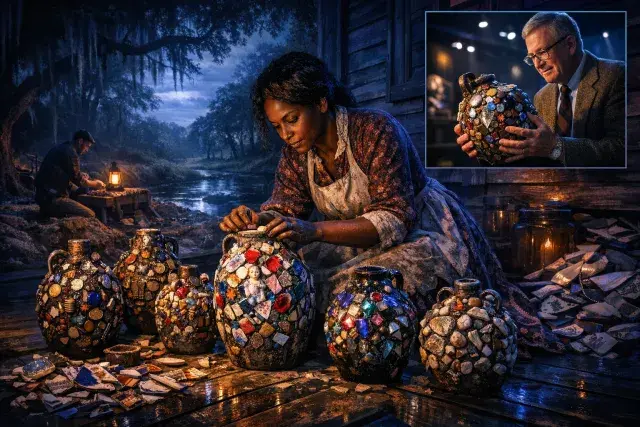
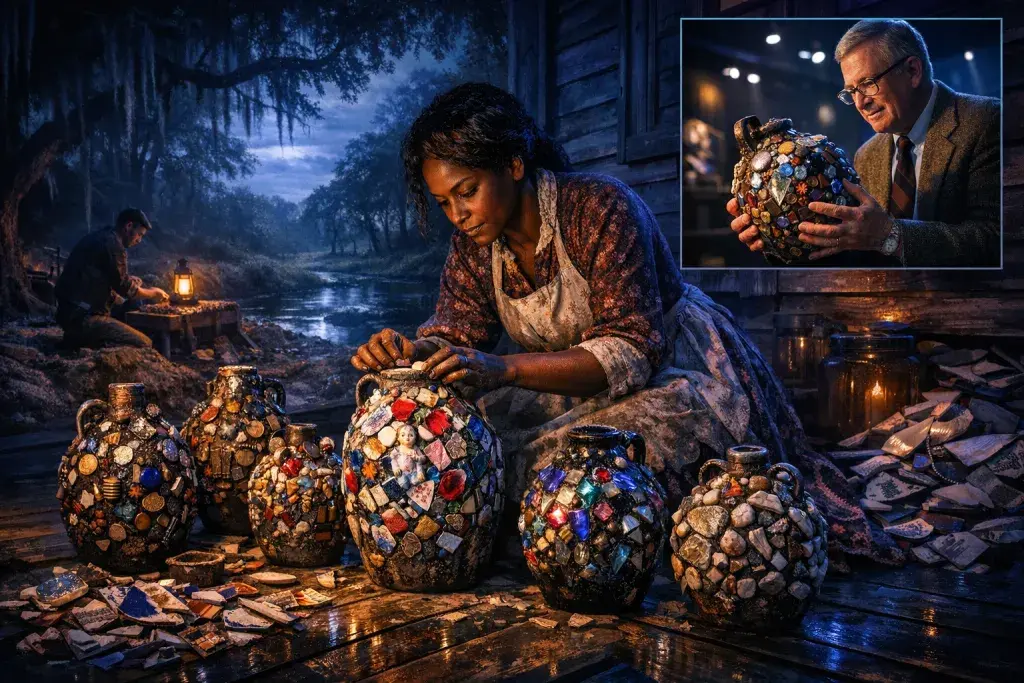
In the late 1800s, Arabella Walker, a farmwoman in South Carolina, fashioned five remarkable jars and pitchers—known as memory jugs—by pressing discarded china shards into gray clay harvested from a nearby creek. These folk art treasures, now celebrated for their personal storytelling, reveal Victorian-era creativity amid scarcity and highlight a fading Southern craft tradition that blended mourning rituals with domestic hobbies.
Arabella Walker's Unique Creations
Walker gathered broken china fragments from behind her farmhouse, embedding them into stoneware forms dug from creek clay. One standout piece, a turn-of-the-century vase, features china on the front and glass on the back with a hanging hole. A family descendant later recreated her technique using arrowheads and Native American pottery from the same farm, underscoring the jugs' enduring legacy.
- Materials: Gray creek clay base, pressed china shards, glass accents
- Style: Dense "conglomeration" of shards evoking personal memories or tributes
- Quantity: Five jars and pitchers, exemplifying peak memory jug production
Origins and Evolution of Memory Jugs
Memory jugs emerged in the late 19th century Deep South, evolving from African American grave decorations to widespread home crafts. Instructions appeared in Godey's Lady's Book during the 1870s-1890s, aligning with Victorian obsessions for scrapbooking and collecting. Women's newfound leisure from household inventions fueled this hobby, spreading beyond the South—evidenced by a Baltimore jug with a fire marshal badge.
Objects pressed into the soft clay or putty varied widely: coins, toys, nuts, bolts, even screen door springs, reflecting the maker's life or honoree. Coins and tokens provide dating clues; a 1887-engraved piece pins its origin precisely.
Expert Insights from Dr. Rodger Stroup
South Carolina historian Dr. Rodger Stroup, who curated 1980s exhibits on funerary customs at the State Museum, demystifies these enigmatic vessels. Initially tied to death rituals, research now views them as versatile crafts. Stroup notes their impermanence—items often fall off, leaving intriguing imprints like toy horses, adding to their charm and historical puzzles.
- Research shift: From grave-only to broad craft tradition
- Dating aids: Coins (earliest date), tokens (latest possible)
- Challenges: Provenance often unknown, frustrating curators
Cultural Legacy and Modern Revival
Despite undervaluation—once dismissed as "trash" at auctions—memory jugs connect to broader folk art trends, preserving personal narratives in a mass-produced era. Today, online tutorials and exhibits at places like the Diggs Gallery inspire recreations, while eBay offers chances for collectors. Stroup hunts early examples, recognizing their role in Southern cultural heritage amid growing interest in vernacular art.
Arabella Walker's jugs exemplify how everyday women transformed refuse into memory vessels, bridging past rituals with timeless creativity.