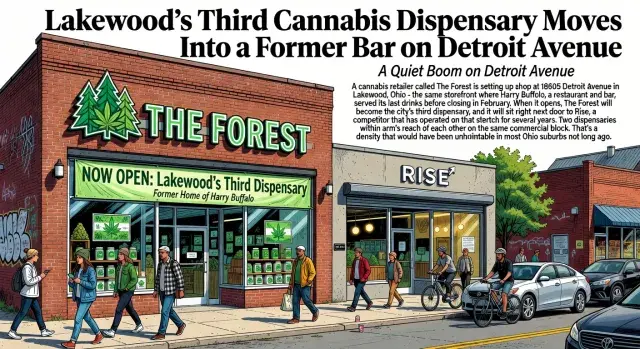
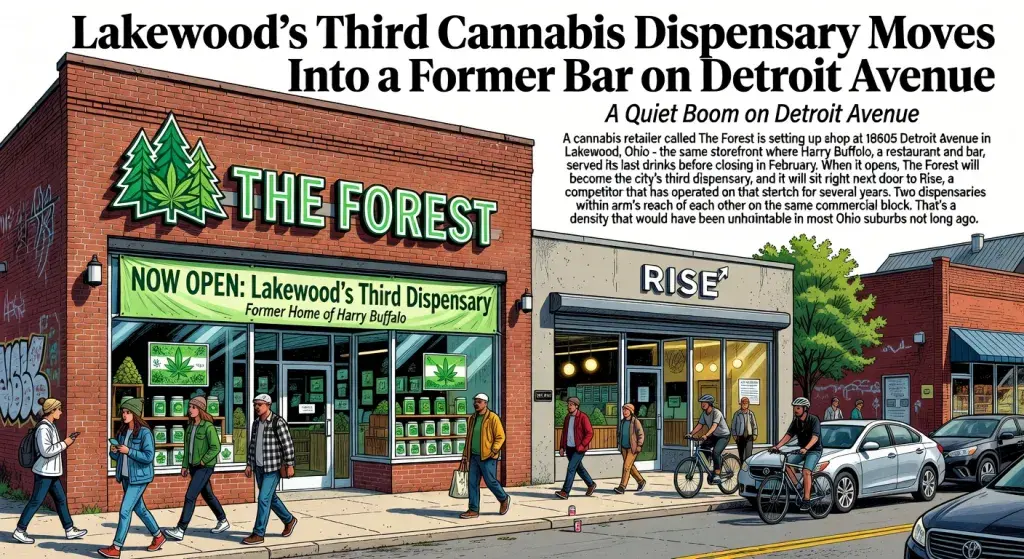
A cannabis retailer called The Forest is setting up shop at 18605 Detroit Avenue in Lakewood, Ohio - the same storefront where Harry Buffalo, a restaurant and bar, served its last drinks before closing in February. When it opens, The Forest will become the city's third dispensary, and it will sit right next door to Rise, a competitor that has operated on that stretch for several years.
A Quiet Boom on Detroit Avenue
Two dispensaries within arm's reach of each other on the same commercial block. That's a density that would have been unthinkable in most Ohio suburbs not long ago. But Lakewood - an inner-ring suburb of Cleveland with roughly 80,000 residents packed into fewer than six square miles - has moved with the tide rather than against it.
Ohio voters approved recreational cannabis in November 2023, and adult-use sales began in August 2024. The state's rollout has been faster than some predicted, though not without the zoning fights, licensing bottlenecks, and municipal opt-out debates that accompany legalization everywhere it lands. Lakewood, for its part, opted in. And the financial returns are already tangible.
The Money Has Started Arriving
Here's the part that tends to quiet skeptics at city council meetings: Lakewood recently received its first installment of state tax revenue tied to hosting cannabis businesses. The figure was $743,400. Not transformative on its own for a city budget, but not trivial either - and it's a recurring revenue stream, not a one-time windfall.
Ohio distributes a portion of its cannabis excise tax to municipalities that allow dispensaries to operate within their borders. The logic is straightforward: if you absorb the regulatory burden and any downstream community effects, you get a cut. Cities that ban dispensaries receive nothing. This creates a fiscal incentive that has nudged more than a few Ohio municipalities from cautious opposition toward reluctant acceptance - and, in some cases, outright enthusiasm.
Whether Lakewood's share grows depends on sales volume, the number of licensed operators in the city, and state-level decisions about tax rates and distribution formulas. A third dispensary will, all else equal, push revenue upward. How much is harder to say without sales data specific to the market.
What We Don't Know Yet
The Forest hasn't announced an opening date or operating hours, at least not publicly as of this writing. Its website confirms the Lakewood location but offers little beyond that. No word yet on whether it will carry both medical and adult-use products from day one, or what its product focus might be - flower-heavy, concentrate-forward, edibles-first. These distinctions matter to consumers but tend to emerge only after a dispensary opens its doors and finds its clientele.
What is clear: the conversion of a bar into a dispensary is a small but telling signal about where consumer spending - and commercial real estate demand - is shifting in Ohio's suburban corridors. Detroit Avenue has long been Lakewood's main commercial artery, a mix of independent restaurants, shops, and the occasional chain. A dispensary replacing a bar on that strip isn't ironic, exactly. But it rhymes.
The Bigger Pattern
Lakewood isn't unique here. Across Ohio and in other states that have recently legalized adult-use cannabis, suburban municipalities are watching a familiar pattern unfold: early resistance gives way to pragmatic acceptance, dispensaries cluster in commercially zoned areas, and tax revenue starts flowing. The tension - between residents who welcome the businesses and those who'd rather they set up elsewhere - doesn't vanish. It just gets quieter once the checks clear.
Three dispensaries in a city Lakewood's size is notable but not extreme. The real question, one that won't be answered for a year or two, is whether the local market can sustain that concentration or whether proximity breeds a price war that thins the herd. For now, The Forest is moving in. Rise is already there. And Lakewood is cashing the checks.