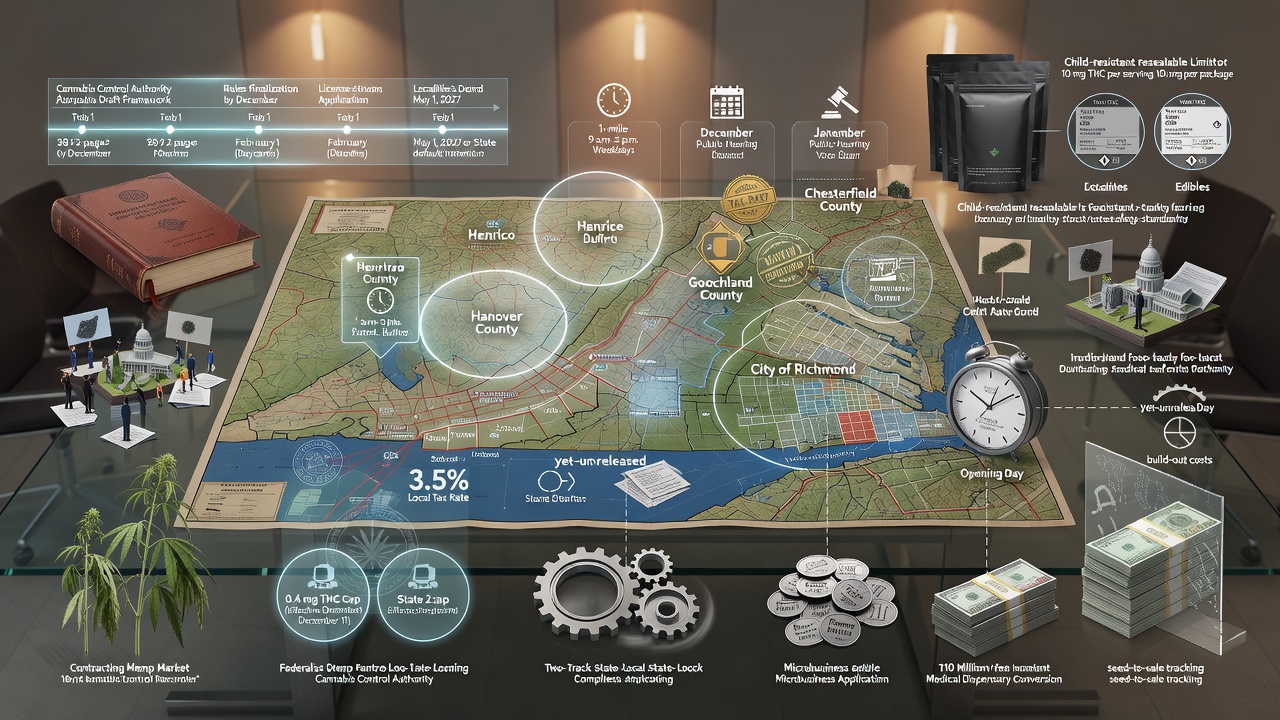
Virginia's recreational cannabis market has a firm start date - July 1, 2027 - and the eight months between now and then will decide who gets to sell, where they can open, and how much it costs to get in the door. For operators eyeing the Richmond region, the real work is happening right now in county zoning offices and in the Cannabis Control Authority's rulemaking process, not on the sales floor.
A compressed regulatory timeline with little room for error
The state's Cannabis Control Authority, which has overseen medical cannabis since 2024, released an eighty-two-page draft framework in September and is expected to finalize rules in December. Those rules need to be in effect by the time license applications open February 1, which leaves almost no cushion for delay. Localities, meanwhile, have their own deadline: every city and county in Virginia must set its own zoning and operating rules by May 1, 2027, or default to whatever the state allows.
That two-track structure - state licensing rules on one side, local zoning on the other - is familiar to anyone who has opened a dispensary in a newly legal state. It also means an operator can hold a valid state license and still be unable to open a store if local zoning hasn't caught up, or if the locality bans retail outright.
Local rules are already diverging sharply
Henrico County voted November 10 to allow shops with a special permit, a public hearing, and Board of Supervisors approval, setting a 1,000-foot buffer from schools, daycares, parks, churches, and libraries. Existing medical dispensaries are exempt from that buffer. Henrico also adopted the maximum local tax rate of 3.5 percent, which suggests the county sees retail cannabis as a revenue opportunity rather than something to discourage.
Hanover is moving in the opposite direction. Its October draft would push the buffer to a full mile from schools, hospitals, daycares, parks, and other cannabis or hemp businesses, and would restrict store hours to weekdays, 9 a.m. to 5 p.m. - a schedule that would functionally eliminate weekend retail traffic, typically a significant share of dispensary volume elsewhere. A public hearing is set for January.
Goochland is targeting the 3.5 percent tax rate and hopes to finalize zoning by March 2027, ahead of the state's May deadline. Chesterfield has a public hearing scheduled for December with a possible Board vote in January. Richmond itself, which already regulates medical dispensaries and restricts hemp and vape retail locations, has not yet released recreational zoning plans - a gap that matters given the city's population and foot traffic relative to surrounding counties.
- Buffer zones, hours, and tax rates will vary block by block across the metro area
- Operators need separate compliance review for every jurisdiction, not just a state license
- Local permitting delays could leave licensed businesses unable to open on July 1
Product rules tighten before the legal market even opens
Edibles sold through licensed adult-use stores will be capped at 10 mg of THC per serving and 100 mg per package, manufactured in facilities subject to food safety law rather than home kitchens. Packaging must be child-resistant, resealable, opaque, and free of imagery designed to appeal to minors, with labels disclosing total THC and CBD content, serving size, and servings per package - standard compliant-packaging requirements seen in other regulated markets, now being written into Virginia's framework.
The hemp side of the market is contracting fast, and that's reshaping the competitive field before recreational stores even exist. A federal cap limiting hemp products to 0.4 mg of THC per container takes effect December 11, following an earlier state cap of 2 mg that already pushed some retailers out of business. Hemp oversight is also shifting from the Department of Agriculture to the Cannabis Control Authority, consolidating enforcement under one regulator. For vape shops and hemp retailers that built a business model around intoxicating hemp products, the math increasingly doesn't work - and the adult-use market they'd need to pivot into won't open for another seven months after the federal rule lands.
Licensing favors incumbents, with equity provisions still untested
Virginia's law allows up to 350 retail licenses statewide, though a state market study recommends starting closer to 163 and phasing in additional licenses over time. Existing medical dispensary operators can apply to convert to adult-use sales starting February 1, but face a one-time $10 million conversion fee - a cost only well-capitalized, already-operating businesses can absorb, which effectively guarantees medical operators a head start on day one.
Separately, the state has reserved its first one hundred microbusiness licenses for applicants from communities most affected by cannabis enforcement, along with hemp growers, processors, and qualified farmers, with a lottery if applications exceed available licenses. Draft rules put microbusiness license fees in the low thousands of dollars, but the larger costs - build-out, security systems, POS infrastructure, seed-to-sale tracking integration, initial inventory - remain the real barrier to entry. A loan fund tied to licensing fees is intended to help offset that, though the state hasn't specified how much funding it will actually hold.
An indictment against a sitting state senator tied to her ownership stake in a cannabis shop has also raised questions about insider influence in how licenses get allocated. Advocacy groups, including the Cannabis Small Business Association and Marijuana Justice, are pressing regulators to prevent consolidation by a small number of well-funded operators before the market even opens - a concern that echoes early licensing disputes in other adult-use states, where social equity goals and market concentration pulled in opposite directions.