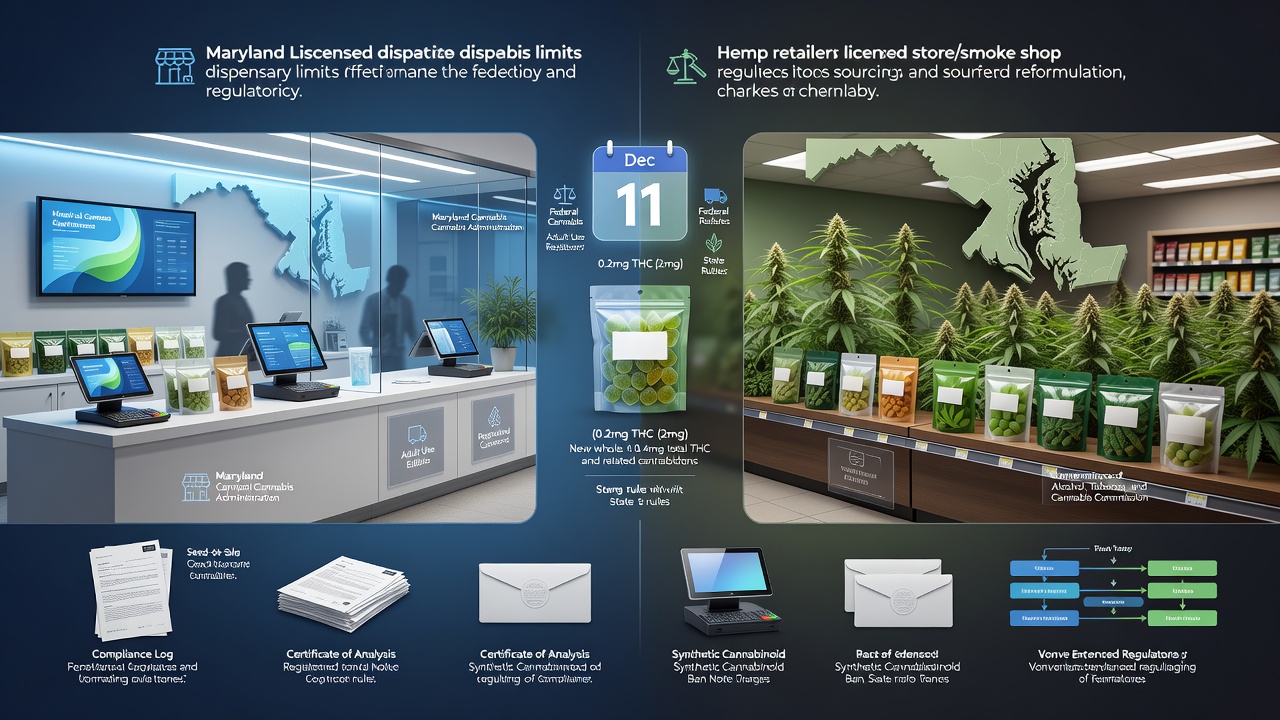
Maryland's licensed dispensaries aren't changing a thing in December. What's actually shifting is federal policy on hemp-derived products sold outside the state's cannabis licensing system - and that distinction matters a lot for anyone stocking shelves, writing compliance logs, or running a point-of-sale system in this state.
Two Regulatory Systems, Two Sets Of Rules
Maryland runs a dual-track structure. Licensed dispensaries operate under the Maryland Cannabis Administration, selling adult-use edibles capped at 10 milligrams of THC per serving and 100 milligrams per package. Medical cannabis patients and registered caregivers get access to stronger formulations, but that's gated behind registration, not open retail. Outside that licensed channel, Maryland already caps hemp-derived gummies at 0.5 milligrams of THC per serving and 2.5 milligrams per package - thresholds enforced through the Alcohol, Tobacco, and Cannabis Commission, not the cannabis administration. These are state-level rules, and they aren't moving in December. What's changing is a separate, federal definition of what counts as "hemp" at all.
Why December 11 Matters For Hemp Retailers, Not Dispensaries
Congress pushed most of the new federal hemp provisions from November 12 to December 11, with one piece - the ban on synthetic cannabinoids the plant doesn't naturally produce - taking effect on the original date. Starting Dec. 11, the federal hemp definition shifts from a dry-weight THC calculation to a whole-container cannabinoid count. Products lose federal hemp status if the entire package exceeds 0.4 milligrams of total THC and related cannabinoids. That's a container-level test, not a per-serving one, and it's a meaningfully tighter bar than what most hemp brands have operated under since the 2018 Farm Bill.
Here's where it gets interesting for wholesale buyers and brand managers: a bag of ten gummies at 0.2 milligrams of THC each clears Maryland's per-serving and per-package thresholds for non-licensed retail. But that same bag totals 2 milligrams of THC - five times over the new federal container limit. A product fully compliant with Maryland's hemp rules could still fall outside federal hemp status once the new math applies. That gap is the whole story here.
Operational Implications For Retailers And Suppliers
For convenience stores, smoke shops, and other non-dispensary retailers carrying hemp gummies, this isn't a labeling footnote - it's a sourcing problem. Brands will need updated certificates of analysis reflecting total container cannabinoid content, not just per-serving breakdowns, and wholesale buyers should expect some SKUs to disappear from vendor menus entirely as manufacturers reformulate or exit the market. Retailers without a cannabis license should audit current inventory against both the state's per-serving/per-package thresholds and the incoming federal container test - products can fail one, the other, or both.
Licensed dispensaries face a different, quieter implication: as federal hemp rules tighten, the regulatory gap between hemp retail and licensed cannabis retail narrows. That could shift some consumer demand back toward the dispensary channel, where potency limits are already clearly defined and enforced through seed-to-sale tracking. Fair enough to call that a modest tailwind, but it's not a strategy - it's a byproduct of federal rulemaking that dispensary operators should watch, not bank on.
- Maryland dispensary limits (10mg/serving, 100mg/package) remain unchanged under state cannabis regulations.
- Non-licensed retail hemp limits (0.5mg/serving, 2.5mg/package) also remain unchanged under state law.
- New federal hemp definition, effective Dec. 11, caps total container THC and related cannabinoids at 0.4 milligrams.
- Synthetic cannabinoids not naturally produced by the cannabis plant lose federal hemp status starting Nov. 12.
None of this changes what's legal to buy at a Maryland dispensary. It does mean retailers outside that system - and the brands supplying them - have a compliance deadline worth building a checklist around before mid-December.