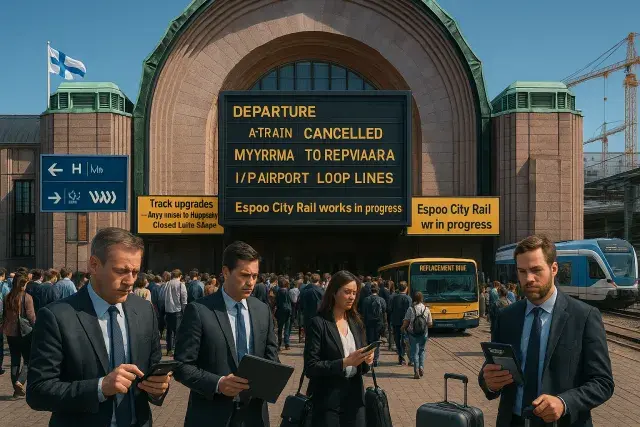
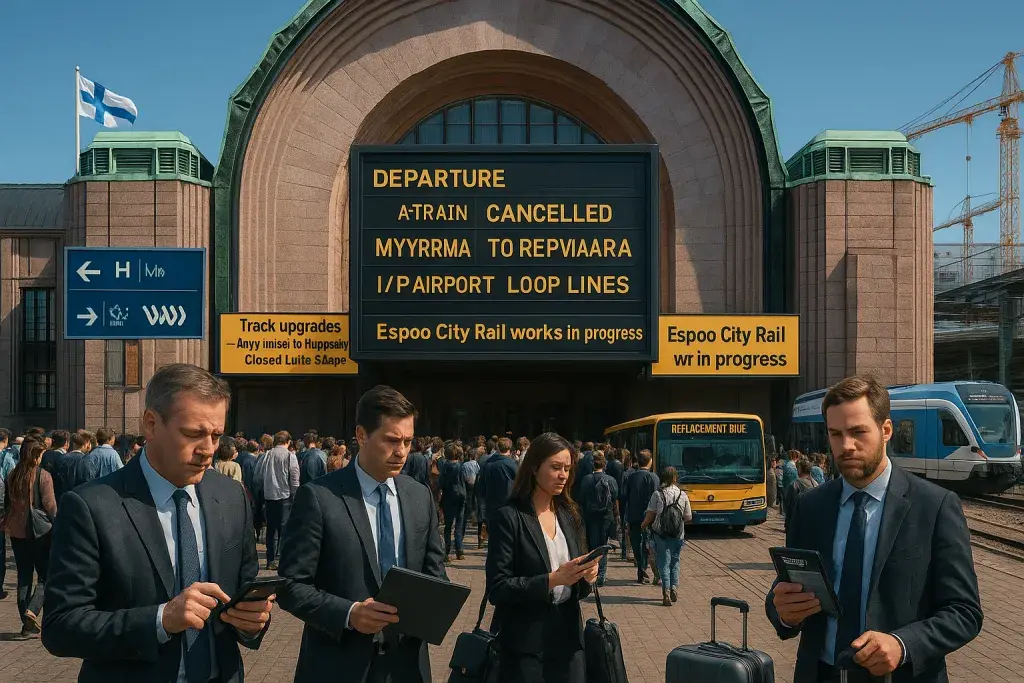
Finland's commuter-rail network faces its most significant operational interruption in recent memory this summer, with Helsinki Regional Transport Authority HSL warning of widespread service changes running from 1 June through early September 2026. Track upgrades, bridge repairs, and the ongoing Espoo City Rail construction will close sections of line, eliminate several station stops, and stretch journey times across the region's busiest corridors. For mobility managers, corporate travel teams, and any business with employees commuting into Espoo's tech districts, the disruptions are substantial enough to require active planning - not just a note in the calendar.
What the Disruptions Actually Mean on the Ground
The headline impact is a complete suspension of rail traffic between Myyrmäki and Huopalahti from 1 June to 9 August. That closure directly affects the I and P lines - the airport loops that connect Helsinki-Vantaa to the city centre - pushing passengers onto replacement buses or forcing rerouting through alternative rail paths. Neither option is quick.
The A-train, which runs between Helsinki Central and Leppävaara and carries a significant share of business travellers heading to western Espoo, will not operate at all this summer. And for five weeks after Midsummer, long-distance services west of Leppävaara will also be curtailed. That is three overlapping disruptions hitting the same general corridor at the same time.
Airport connectivity takes a measurable hit as well. Flights are unaffected, but I-trains that continue to run will skip four suburban stations and drop to a 20-minute frequency - double the usual interval. Outside peak hours, that means travellers connecting to or from Helsinki-Vantaa should add meaningful buffer time to any itinerary that depends on a rail transfer.
The Implications for Corporate Travel and Mobility Teams
Here's the practical problem for anyone managing business travel into Finland this summer: the disruptions are long, layered, and difficult to route around without explicit advance planning. Car-rental firms and ride-hail operators are already anticipating higher demand, which typically means reduced availability and higher prices at peak times. Hotels are warning guests of possible delays. In short, the secondary effects on ground transport across the Helsinki metropolitan area could extend well beyond the rail lines themselves.
For international business travellers, the administrative side of the trip deserves equal attention. Entry requirements, visa processing timelines, and passport logistics are easily overlooked when itinerary changes absorb the planning bandwidth. Services that handle visa applications and associated formalities - such as VisaHQ's dedicated Finland page at https://www.visahq.com/finland/, which lists current entry requirements and processes online applications for numerous nationalities - can reduce that administrative friction at a moment when travel schedules are already under pressure.
For employers with large commuter populations in Espoo's Keilaniemi and Otaniemi business districts specifically, HSL's timeline suggests this is not a short-term inconvenience. Thirteen weeks of disruption justifies updating travel-approval tools to build in extra transfer time, revisiting remote-work policies for affected staff, and considering staggered start times to spread demand across the replacement bus network. HSL notes that accessibility buses will serve passengers with reduced mobility at closed stations - a detail worth confirming in advance for any traveller who needs it.
Planning Tools and the Longer Context
Real-time route alternatives are available in English through HSL's Reittiopas journey planner, and the agency will push live disruption alerts through its mobile app. That matters - replacement bus routes and timetables during multi-month works programmes tend to shift, and relying on a static itinerary printed before departure is a reliable way to miss a connection.
What's striking here is the scale of the underlying investment. HSL frames these disruptions explicitly as preparation for new commuter rolling stock arriving in 2028, and the Espoo City Rail project is a long-term capacity expansion on Finland's busiest rail corridor. The disruption is the cost of a network that will eventually carry more passengers more efficiently. That context doesn't make a missed airport connection any less frustrating, but it does mean the works are unlikely to be shortened or paused - mobility managers should treat the September end date as firm and plan accordingly.
The short version: if your organisation has people travelling to or through Helsinki this summer, build the extra time in now, confirm visa and entry requirements well in advance, and don't assume the usual rail journey times will hold.