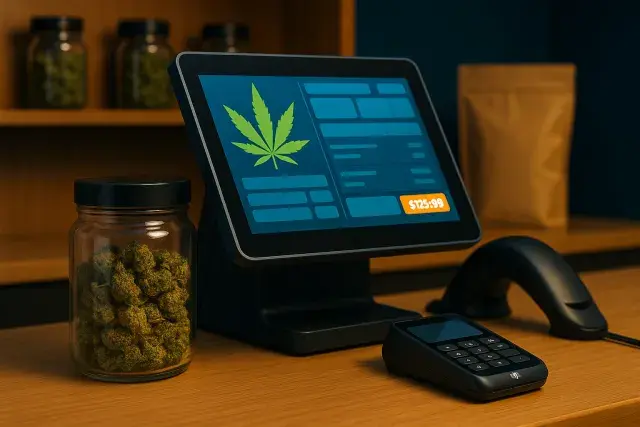
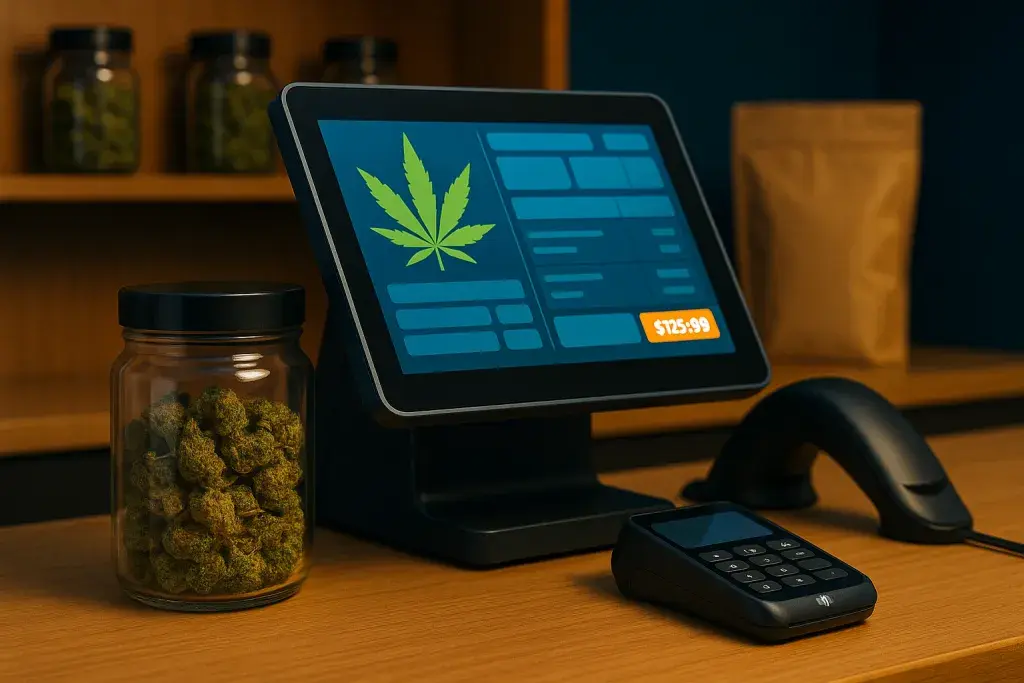
Running a cannabis dispensary without the right technology is like managing a pharmacy with a cash register and a notepad. Compliance violations, inventory discrepancies, and slow checkout lines aren't minor inconveniences - they can cost licenses, customers, and revenue. The software sitting at the center of your operation carries more weight than most dispensary owners realize until something goes wrong.
Choosing a cannabis retail POS system is one of the most consequential infrastructure decisions a dispensary will make. The right platform touches every corner of the business: how products move from receiving dock to display case, how budtenders ring up sales, how managers file compliance reports, and how customers experience the checkout process. Operators who approach this decision with clear criteria tend to build more efficient, compliant, and profitable shops. Those who choose based on price alone often pay more in workarounds and penalties later. Understanding what good dispensary point-of-sale software actually does - beyond processing transactions - is where the evaluation needs to start.
This guide breaks down every layer of the decision: compliance requirements, inventory architecture, checkout workflows, integration ecosystems, and vendor accountability. Whether you're opening your first location or replacing a system that no longer fits, the framework here will help you evaluate options with precision rather than guesswork.
Understanding What a Cannabis POS System Actually Does
Beyond the Transaction: The Full Scope of a Cannabis POS
Most business owners think of a point-of-sale system as the tool that processes payments. In cannabis retail, that framing misses roughly 80 percent of what the software actually manages. A cannabis point of sale platform is the operational backbone of a dispensary - it connects compliance reporting, product catalog management, staff permissions, customer records, and financial reconciliation into a single environment.
When a customer walks in and a budtender begins building an order, the system is simultaneously checking purchase limits against state regulations, pulling real-time product availability from the inventory layer, applying loyalty discounts, and preparing the transaction data for seed-to-sale reporting. Every one of those functions has to happen accurately and quickly. A platform that handles payments but stumbles on compliance reporting or inventory sync creates downstream problems that compound over time.
The distinction between a generic retail POS and one built specifically for cannabis is not cosmetic. Cannabis-specific platforms are architected around regulatory constraints that general retail software was never designed to accommodate. Attempting to adapt a standard retail system to cannabis compliance is rarely worth the technical overhead.
Core Modules Every Dispensary POS Should Include
When evaluating any cannabis retail POS system, the core modules should include the following capabilities without requiring significant add-ons or third-party patches:
- Seed-to-sale tracking integration with state compliance systems such as Metrc, BioTrackTHC, or LEAF
- Real-time inventory management synced to the sales floor
- Customer profile management with purchase history and limit tracking
- Staff role management with granular permission controls
- End-of-day reporting and cash reconciliation tools
- Integration with dispensary menus and online ordering platforms
If a vendor presents these features as premium upgrades rather than baseline functionality, that tells you something important about their product's design philosophy and who they built it for.
Regulatory Complexity and Why It Shapes POS Architecture
Cannabis retail operates under a patchwork of state and sometimes municipal regulations that affect everything from daily purchase limits to how patient records are stored. A POS system built for this environment has to enforce those rules at the point of transaction, not after the fact. That means real-time limit checking, automatic flagging of non-compliant sales, and audit-ready reporting built into the core workflow rather than bolted on as an afterthought.
States using Metrc, for example, require that every package moved in a dispensary be tracked with a unique identifier that reports back to a state database. The POS system has to communicate with that database reliably. Any lag or sync failure creates discrepancies that trigger compliance audits. Understanding this architecture is essential before signing any vendor contract.
Compliance Integration: The Non-Negotiable Foundation
Seed-to-Sale Tracking and State Reporting Requirements
Regulatory compliance is not a feature a dispensary can opt out of, which means the compliance capabilities of your marijuana dispensary management software are the first filter in any vendor evaluation, not the last. Every state with legal cannabis sales has a mandated tracking system, and your POS must integrate with it directly and reliably.
Metrc is the most widely deployed state tracking system in the United States, currently used in more than two dozen states. A POS that integrates with Metrc must handle package transfers, adjustments, and sales reporting automatically, without requiring staff to manually enter data into a separate portal. Manual dual-entry is a compliance risk - humans make errors, and errors in state systems trigger investigations.
When evaluating vendors, ask specifically how they handle Metrc sync failures. What happens when the state API is down? Does the system queue transactions and sync when connectivity is restored? Does it alert staff in real time? The answer reveals how seriously the vendor has thought about operational resilience.
Purchase Limit Enforcement and Age Verification
Every jurisdiction sets daily or transaction-level purchase limits on cannabis products, often varying by product type. Medical programs typically allow higher limits than adult-use programs, and some states differentiate between flower, concentrates, and edibles using potency equivalencies. Your POS system must calculate and enforce these limits automatically at the point of sale.
Age verification is equally non-negotiable. The POS should require ID scanning before a transaction begins, log the verification, and flag any attempt to complete a sale without it. Systems that treat age verification as a checkbox rather than a gated workflow create both compliance exposure and liability risk.
Audit Trails and Reporting for Regulators
Regulatory agencies can request records with little notice, and having clean, comprehensive audit trails is the difference between a smooth inspection and a protracted investigation. Your marijuana dispensary management software should maintain immutable logs of every transaction, inventory adjustment, voided sale, and staff action.
The reporting tools should be capable of generating the specific report formats regulators in your state require, not just generic data exports that require reformatting. Ask vendors for examples of the compliance reports their system generates and verify those formats against your state's current requirements.
Dispensary Inventory Tracking Software: Managing Stock with Precision
How Inventory Tracking Works in a Cannabis Context
Inventory management in cannabis retail is more demanding than in most other product categories. Products carry state-issued package tags that must remain associated with those products through every stage of the sales cycle. Receiving, adjusting, transferring, and selling inventory all generate compliance events that must be reported accurately. Dispensary inventory tracking software has to handle all of this while also giving floor staff real-time visibility into what's available.
The inventory layer of a cannabis POS should support batch receiving, where products arrive with pre-assigned package IDs that are scanned into the system and immediately associated with the correct Metrc tags. From that point forward, every unit sold or adjusted should automatically decrement from the correct package in both the POS and the state tracking system simultaneously.
Discrepancies between POS inventory and state records are among the most common findings in dispensary compliance audits. The most reliable way to prevent them is to use a system where those two data sets are always in sync by design, not by manual reconciliation.
Real-Time Inventory Visibility and Low-Stock Alerts
Beyond compliance, strong dispensary inventory tracking software gives managers operational control over purchasing decisions. Real-time inventory counts visible to both floor staff and management eliminate the frustration of customers asking for products that aren't actually in stock. Low-stock alerts help managers reorder before items run out entirely rather than discovering gaps during a busy shift.
The system should allow managers to set reorder thresholds by product category or individual SKU, and ideally generate purchase order suggestions based on historical sales velocity. This moves inventory management from reactive to proactive, which has a meaningful impact on revenue consistency.
Handling Returns, Adjustments, and Waste
Cannabis retail generates inventory adjustments that don't exist in other industries: product destruction, waste reporting, and returns to distributors all require specific handling in both the POS and the state tracking system. A system that handles standard sales cleanly but struggles with adjustments will create compliance gaps over time.
Verify that your vendor supports the full range of inventory adjustment types required in your state, and that those adjustments flow automatically to Metrc or your state's equivalent system. Ask to see the adjustment workflow during any product demonstration.
Dispensary Checkout Software: Designing a Fast, Accurate Sales Floor
The Checkout Workflow and Its Impact on Customer Experience
The checkout experience is where all the back-end infrastructure either pays off or falls apart. Slow checkout lines, payment processing errors, and product lookup failures all translate directly into customer dissatisfaction. Dispensary checkout software should be designed to make the budtender's job fast and intuitive while enforcing all compliance requirements without slowing the transaction.
A well-designed checkout interface presents product search, cart management, compliance limit checking, discount application, and payment processing in a logical sequence that a trained budtender can complete in under two minutes for a standard transaction. That speed comes from interface design decisions made during the platform's development. When evaluating systems, time a mock transaction during the demo. If it takes a vendor representative more than a few minutes to walk through a basic sale, front-line staff will struggle even more.
Payment Processing in Cannabis Retail
Payment processing remains one of the most operationally complex aspects of cannabis retail due to federal banking restrictions. Most dispensaries operate with a mix of cash, debit PIN transactions, and in some markets cashless ATM systems. Your cannabis point of sale platform must support these payment types reliably and handle the accounting correctly for each.
Ask vendors how their system handles cash drawer management, cash drop documentation, and end-of-day cash reconciliation. These workflows are where theft and shrinkage often go undetected, and a POS with strong cash management controls gives managers visibility they wouldn't otherwise have. Some platforms also support pre-payment through online ordering integrations, which can reduce checkout time significantly for returning customers.
Customer Profiles, Loyalty Programs, and Personalization
Returning customers drive a disproportionate share of dispensary revenue, and checkout software that supports meaningful customer relationship tools gives dispensaries a competitive edge. Customer profiles should capture purchase history, product preferences, loyalty point balances, and any medical recommendations relevant to purchase limits.
Loyalty programs work best when they're embedded in the checkout flow rather than managed in a separate application. When a budtender rings up a sale, the system should automatically apply available rewards and update the customer's balance in real time. Friction in the loyalty redemption process reduces program participation, which reduces the value of collecting that customer data in the first place.
Marijuana Dispensary Management Software: Running the Back Office
Staff Management, Permissions, and Accountability
A dispensary POS is also a staff management tool. Marijuana dispensary management software should support granular role-based permissions that control what each employee can see and do within the system. A budtender doesn't need access to financial reports. A manager who can approve voids shouldn't need system administrator credentials. Tight permission controls reduce both error risk and internal theft exposure.
The system should log every staff action with a timestamp and user ID, creating an accountability trail that managers can review when discrepancies arise. This isn't about distrust - it's about having the data to distinguish between honest mistakes and intentional misconduct when those situations inevitably occur.
Reporting, Analytics, and Business Intelligence
The data generated by a dispensary POS is one of the most valuable assets the business owns, provided the system makes that data accessible and interpretable. Management dashboards should show real-time sales performance, top-selling products, average transaction value, and staff performance metrics without requiring database queries or spreadsheet exports.
Historical trend analysis helps managers make smarter purchasing decisions, identify underperforming product categories, and evaluate the impact of promotions. If a vendor's reporting capabilities are limited to basic transaction logs and daily sales totals, that's a significant constraint on the business intelligence value of the platform.
Multi-Location Management
Dispensary operators with more than one location need centralized visibility across their entire portfolio from a single management interface. The ability to compare performance across locations, manage a shared product catalog, and standardize operational procedures from a central admin console is the difference between scalable growth and per-location chaos.
If expansion is part of your business plan, evaluate whether the platform you're considering was architected for multi-location operations or whether it treats each location as a separate installation. The answer has long-term implications for both operational efficiency and data coherence.
Integration Ecosystem: Connecting Your Tech Stack
Online Menus and E-Commerce Integrations
The majority of cannabis customers research products before arriving at a dispensary, and a growing percentage complete transactions through online ordering. Your cannabis retail POS system should integrate with the major cannabis menu and e-commerce platforms - such as Dutchie, Jane Technologies, or Leafly - and keep product availability and pricing synchronized in real time.
Stale menus that show out-of-stock products as available, or list prices that don't match the POS, create frustrated customers and wasted budtender time. The integration between your POS inventory layer and your online menu should be live, not on a scheduled sync interval.
Accounting Software and Financial Integrations
Financial reporting for cannabis businesses is complex, and the POS should reduce rather than add to that complexity. Direct integration with accounting software platforms reduces manual data entry and the errors that come with it. The system should be capable of exporting transaction data, sales tax collected, and cost-of-goods figures in formats compatible with standard accounting workflows.
Cannabis businesses face unique accounting challenges related to Section 280E of the Internal Revenue Code, which limits deductions available to businesses trafficking in controlled substances. Having clean, granular POS data properly categorized by revenue type and cost category makes working with tax professionals considerably more straightforward.
Hardware Compatibility and Infrastructure Requirements
Software capabilities mean little if the hardware infrastructure to support them is unreliable or prohibitively expensive. Evaluate whether the dispensary checkout software runs on standard commercial hardware or requires proprietary equipment available only through the vendor. Proprietary hardware creates vendor dependency that limits your negotiating leverage and can extend repair timelines when equipment fails.
Consider the full hardware stack: terminals, receipt printers, cash drawers, ID scanners, label printers for inventory, and network infrastructure. Ask vendors what happens to point-of-sale operations when internet connectivity goes down. A system with no offline mode is a liability in any location where network reliability isn't guaranteed.
Vendor Evaluation: Choosing a Partner, Not Just a Platform
Implementation, Training, and Onboarding Support
The quality of a vendor's implementation support is at least as important as the quality of their software. A poorly executed implementation of a good platform will underperform a well-executed implementation of a decent one. Ask vendors for a detailed implementation timeline, a description of the onboarding process, and references from dispensaries of similar size and complexity to yours.
Staff training is where many implementations fail. Budtenders who don't understand the POS make errors - compliance errors, cash handling errors, customer service errors. The vendor should provide structured training materials, not just access to a knowledge base. Find out what happens when you hire new staff after the initial implementation: is there an ongoing training resource, or does that cost extra?
Customer Support and System Reliability
A cannabis dispensary operates on schedules that don't align with standard business hours. If your POS goes down on a Friday evening, you need support available immediately. Evaluate the vendor's support structure: what are the support hours, what's the average response time for critical issues, and what escalation paths exist for system-wide outages?
Ask about the platform's uptime history and how they communicate about planned maintenance and unexpected outages. A vendor unwilling to provide uptime data or share post-incident reports for past outages is signaling a lack of operational transparency that will likely frustrate you down the road.
Contract Terms, Pricing Structure, and Exit Clauses
POS vendor contracts in cannabis range from month-to-month arrangements to multi-year commitments, and the terms matter as much as the monthly price. Understand exactly what's included in the base subscription, what triggers additional fees, and what happens to your data if you decide to switch platforms.
Data portability is particularly important. Your customer database, transaction history, and inventory records represent years of business intelligence. Verify that you can export that data in a usable format and that the vendor doesn't restrict access to your own records as a retention mechanism. Also confirm that pricing is locked or has defined escalation caps - open-ended pricing adjustments are a common source of vendor relationship friction.
Frequently Asked Questions
What is the difference between a cannabis POS system and a general retail POS?
A cannabis-specific POS is built to handle seed-to-sale compliance reporting, purchase limit enforcement, and integration with state tracking systems like Metrc - none of which general retail platforms support. Using a general retail POS in a cannabis dispensary typically requires manual compliance workarounds that create audit risk and operational inefficiency.
How does dispensary inventory tracking software connect to state compliance systems?
Most cannabis-specific POS platforms maintain a direct API connection to state tracking systems. When products are received, sold, or adjusted, the POS automatically sends the corresponding transaction data to the state database. This eliminates the need for manual dual-entry and keeps dispensary records synchronized with state records in real time.
Can a cannabis POS system support multiple dispensary locations from one account?
Many enterprise-level platforms support multi-location management through a centralized admin console that provides consolidated reporting, shared product catalogs, and location-level performance comparisons. However, not all systems offer this natively - some treat each location as a separate installation, which limits cross-location visibility and creates data silos.
What payment methods should dispensary checkout software support?
Due to federal banking restrictions, most dispensaries process cash, PIN debit transactions, and cashless ATM payments rather than standard credit card transactions. Your POS should support all of these payment types and manage cash drawer operations, reconciliation, and transaction documentation for each. Some platforms also support pre-payment through online ordering integrations.
How long does it typically take to implement a new dispensary POS system?
Implementation timelines vary depending on the complexity of the operation, but most single-location dispensaries can expect a process of two to four weeks that includes software configuration, hardware setup, data migration, and staff training. Multi-location rollouts take longer. Rushing implementation to meet an arbitrary deadline is one of the most common sources of go-live problems.
What should I ask a POS vendor about data ownership and portability?
Ask specifically whether you can export your full customer database, transaction history, and inventory records at any time in a standard format such as CSV or JSON. Confirm that access to your data is not restricted if you pause payments or initiate a contract termination. Get data portability terms in writing before signing any agreement.