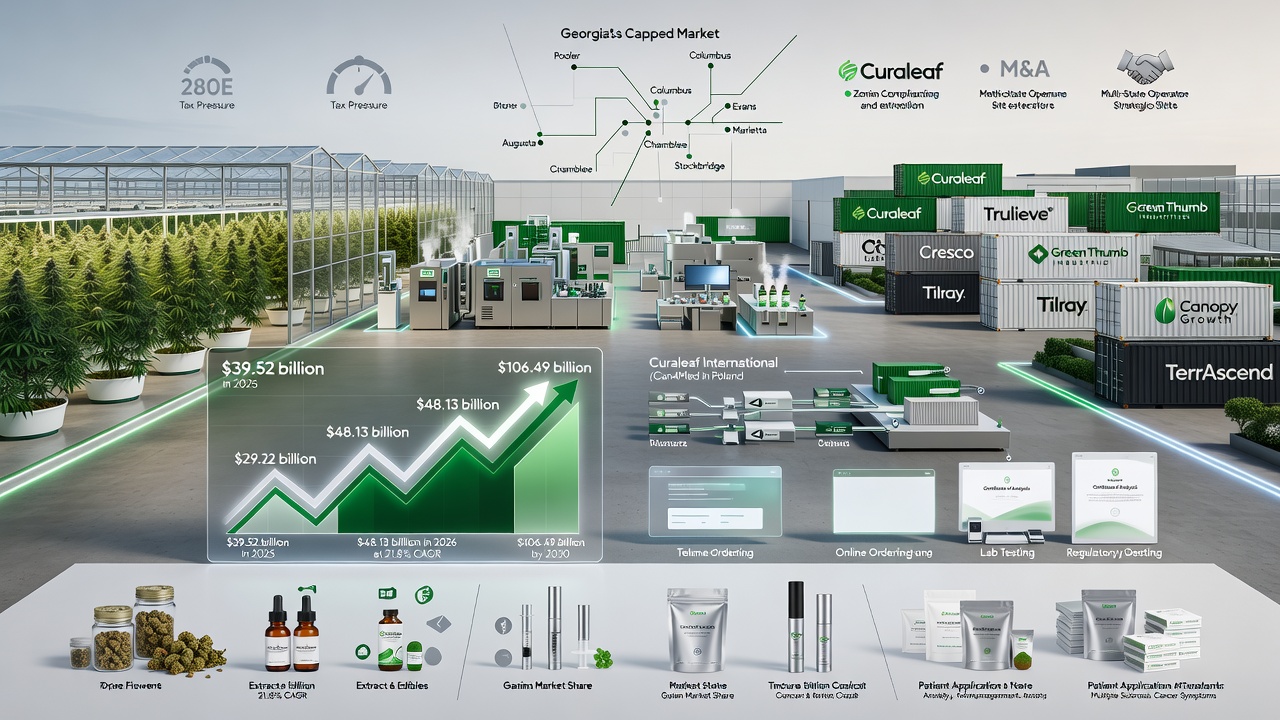
The medical marijuana market is projected to climb from roughly $39.52 billion in 2025 to $48.13 billion in 2026, a 21.8% compound annual growth rate, before reaching an estimated $106.49 billion by 2030. That's not incremental growth - it's a near-tripling in under five years. For multi-state operators, wholesalers, and the compliance teams that keep them licensed, the real story isn't the top-line number. It's whether operational infrastructure can keep pace with it.
What's Actually Driving the Expansion
Several forces are converging here, and they're not all the same kind of pressure. Expanding legalization in new jurisdictions is opening fresh patient populations, while limitations of conventional pharmaceuticals are pushing more physicians and patients toward medical cannabis as an adjunct therapy. Add in advances in extraction and formulation technology - oils, tinctures, concentrates, edibles - and you get a product mix that looks less like a dispensary menu from a decade ago and more like a pharmaceutical catalog. Telemedicine integration for patient certification and online ordering is compounding that shift, letting operators reach patients who might never have walked into a storefront.
None of this happens in a regulatory vacuum, though. Each new market brings its own licensing structure, its own testing requirements, its own packaging and labeling rules. A formulation approved for sale in one state's medical program may need reformulated packaging or a new certificate of analysis before it can move into another. That's a real cost center, not a footnote.
Consolidation and the M&A Calculus
The list of companies competing for share - Curaleaf, Trulieve, Green Thumb Industries, Cresco Labs, Tilray, Canopy Growth, TerrAscend, and dozens more - reflects an industry still sorting out who has the balance sheet to survive 280E tax treatment and who doesn't. Curaleaf International's acquisition of Can4Med, a Polish pharmaceutical manufacturer, in February 2024 is instructive: it's a supply chain play, aimed at strengthening manufacturing capacity and patient access across multiple markets rather than chasing retail square footage alone.
That distinction matters. Vertical integration - controlling cultivation, manufacturing, and retail under one roof - has been the dominant strategy for years, but cross-border manufacturing deals suggest operators are now thinking about supply chain resilience the way traditional pharma companies do. Dried flower may still move the volume, but formulation and extraction capacity is where the margin conversation is heading.
Dispensary Expansion Isn't Automatic
Retail footprint growth is happening too, but it's bounded by license caps and jurisdiction-specific rules. Georgia's medical cannabis framework, for instance, caps operators at six dispensaries each - which is exactly why a provider like Botanical Sciences is methodically opening locations in Pooler, with plans for Columbus, Evans, Augusta, Chamblee, Marietta, and Stockbridge rather than flooding a single metro area. In a capped market, site selection becomes a strategic decision with long-term consequences, not just a real estate transaction.
For operators eyeing expansion, that means zoning compliance, local buy-in, and patient-access analysis all have to happen before a lease gets signed. Get it wrong and a six-license allotment gets burned on underperforming locations.
Segmentation Signals Where the Money Is Going
- Product type: dried flower versus extract form, with extracts gaining share as formulation technology improves
- Formulation: flower, concentrate, edibles, and other delivery methods diversifying patient options
- Application: pain management remains dominant, alongside anxiety, multiple sclerosis, cancer-related symptoms, and other conditions
- Distribution: retail pharmacy channels competing with growing e-commerce and online pharmacy models
For brands and wholesalers, this segmentation isn't academic. It's a roadmap for SKU management and wholesale menu planning. Operators betting heavily on dried flower while extract and edible formulations gain application-specific traction may find their inventory mix out of step with where prescribing patterns are actually moving. Lab testing and COA transparency remain non-negotiable across every format - patient safety and regulatory standing depend on it, regardless of how fast the market grows underneath it.