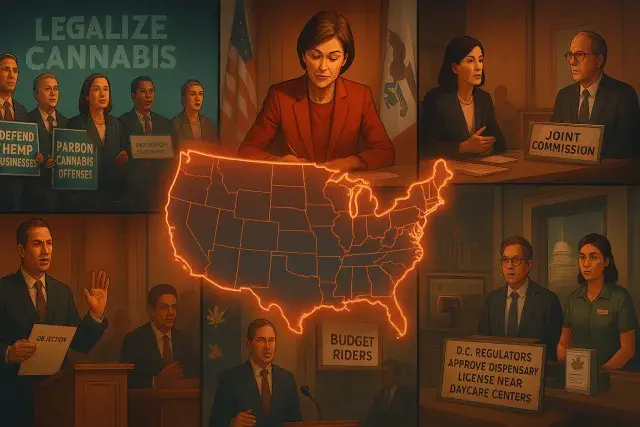
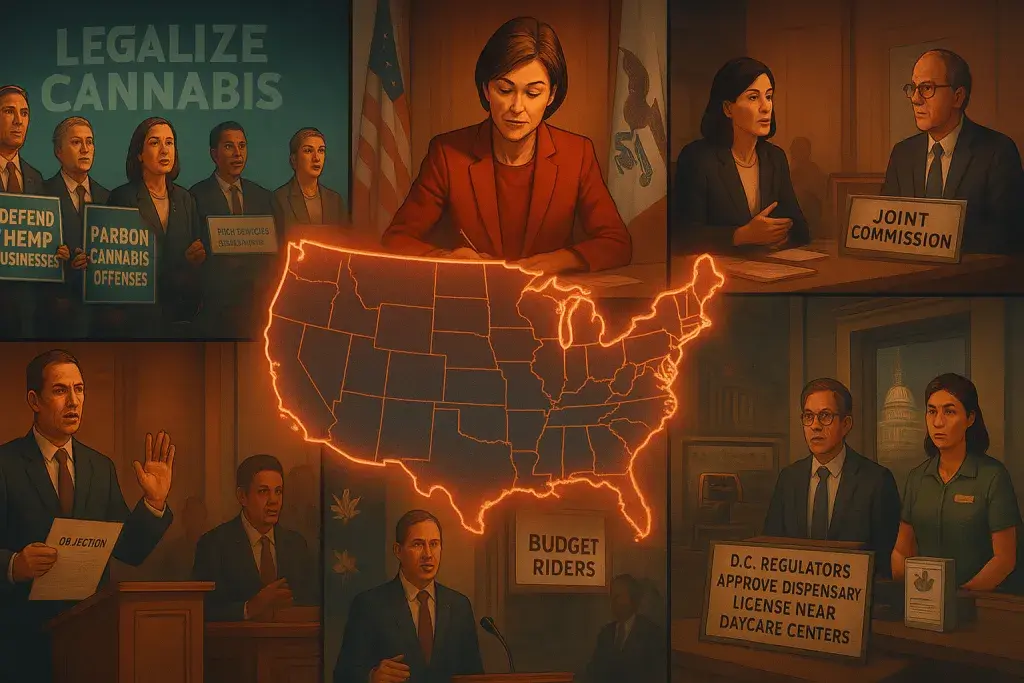
Six Wisconsin Democratic gubernatorial candidates took the stage at a cannabis industry forum this week, each making explicit commitments to advance marijuana legalization, defend hemp businesses from regulatory rollback, and deploy executive pardon powers on behalf of people with cannabis-related convictions. It was an unusually direct alignment between candidates and industry stakeholders - and a signal that cannabis policy is consolidating as a Democratic campaign issue in states where legalization remains stalled. For licensed operators, multi-state investors, and hemp-product companies watching Midwestern market development, the Wisconsin forum is worth tracking closely.
The broader policy picture this week was equally active. State legislatures and governors across the country moved on medical access, dispensary licensing, and adult-use frameworks in ways that carry real operational consequences for cannabis retailers and compliance teams. Virginia's Joint Commission to Oversee the Transition of the Commonwealth into a Cannabis Retail Market held its first meeting since Gov. Abigail Spanberger vetoed recreational sales legislation - with lawmakers now openly discussing the possibility of embedding cannabis reform inside budget legislation due this month. Budget riders are a well-worn workaround in state politics, but they carry their own uncertainty; a provision folded into a spending bill can be traded away in conference as easily as it was inserted. For operators who have been holding capital and watching Virginia's adult-use framework stall, the budget route is not a resolution - it's another variable. Dispensary technology vendors and point-of-sale providers already active in mid-Atlantic markets, including those offering cannabis point of sale maryland solutions, will be watching Virginia's budget timeline as a leading indicator for when infrastructure investment decisions in that state finally make sense.
Iowa moved in a more straightforward direction. Gov. Kim Reynolds signed legislation to double the number of medical cannabis dispensaries that can be licensed in the state, while also opening the program to out-of-state residents who hold a certification from an Iowa healthcare provider. Doubling the dispensary license cap matters structurally: Iowa's program has operated under a tight ceiling, which has constrained wholesale volume, product variety, and competition. More licenses mean more inventory movement, more compliance requirements across a broader operator base, and eventually more price pressure at the wholesale level. The out-of-state patient provision is notable too - it expands the addressable patient pool without requiring new legislative authority over residency, and it places new compliance responsibilities on dispensary staff to verify out-of-state certifications accurately.
Hemp's Regulatory Exposure Grows as State Attorneys General Enter the Debate
Wyoming's attorney general issued a formal objection to rescheduling marijuana under state law - specifically targeting a provision that would have automatically aligned Wyoming's classification with any federal reclassification. The Trump administration's ongoing effort to reschedule cannabis at the federal level had, in some states, been expected to trigger automatic downstream policy adjustments. Wyoming's objection puts a hard stop on that assumption. For hemp businesses operating across state lines, the lesson is clear: federal rescheduling, if and when it happens, will not produce a uniform state-level response. Compliance teams will need to manage a patchwork of state reactions, not a single synchronized shift.
South Carolina's Senate majority leader said this week that he doesn't believe the votes exist in his chamber to advance a ban on hemp THC drinks - a development that will be welcomed by hemp beverage brands and distributors. That said, "the votes aren't there right now" is not the same as a settled policy position. Several states have moved quickly from apparent legislative inertia on hemp THC to aggressive restriction. Retailers carrying hemp-derived THC products should maintain compliant labeling, accurate COAs, and documented age-verification procedures regardless of how stable the current political environment appears. Regulatory exposure in this category remains high.
Medical Access Expansions and Dispensary Licensing Mark Incremental Progress
Pennsylvania's House passed a bill allowing terminally ill patients to use medical cannabis in hospitals, long-term care nursing facilities, assisted living residences, and other healthcare settings. This is a narrow but operationally meaningful change. Dispensary operators and delivery providers who serve medical patients near those facilities will need to understand the specific compliance requirements that attach to institutional settings - documentation, chain-of-custody standards, product form restrictions - before treating this as a straightforward market expansion. The bill still needs to clear the Senate and reach the governor's desk.
Alabama's first medical cannabis dispensary was expected to open Thursday. That's a significant milestone for a state program that has faced repeated delays and legal challenges since its enabling legislation passed. Opening day operations at a first-in-state dispensary are genuinely complex: staff training, POS configuration, seed-to-sale tracking enrollment, and patient verification workflows all converge at once. Regulators and operators in states earlier in that process should take note of how Alabama's launch proceeds - the friction points tend to be instructive.
Washington, D.C. regulators approved a medical cannabis dispensary license despite proximity challenges involving nearby daycare centers, suggesting that local regulators are applying fact-specific analysis rather than blanket buffer-zone disqualifications. That's relevant for operators in other jurisdictions who have faced zoning-based license denials; the D.C. precedent won't bind anyone else, but it illustrates that regulatory bodies can and do weigh evidence individually rather than applying rigid exclusion formulas.
Federal Legislation Moves Slowly; New York and Los Angeles Act on Separate Fronts
On Capitol Hill, several cannabis-related bills picked up new cosponsors this week - including the House bill to federally legalize marijuana, now at 72 cosponsors; the bill to let cannabis businesses list on stock exchanges, at four; the bill to regulate hemp products, at seven; and the bill to delay federal recriminalization of hemp THC products, now at 36. None of these bills are positioned for imminent floor votes, and cosponsor counts in the current Congress reflect advocacy engagement more than legislative momentum. Still, the hemp delay bill's 36 cosponsors represent the broadest bipartisan support among the group - which matters for hemp-derived product companies managing inventory decisions under regulatory uncertainty.
New York lawmakers sent Gov. Kathy Hochul legislation aimed at addressing cannabis product inversion from outside the state - a direct response to the persistent problem of unlicensed product entering New York's regulated retail environment through diversion from other markets. Inversion undercuts licensed dispensary pricing, creates compliance exposure for retailers who can't verify product origin, and erodes tax revenue. It's a structural supply chain problem, and legislation alone rarely solves it without parallel enforcement capacity. Los Angeles voters, separately, approved a ballot measure to impose taxes on unlicensed cannabis businesses - a demand-side enforcement mechanism that targets the gray market's economic viability rather than just its legal status. Whether tax liability actually produces compliance in markets with heavy unlicensed activity depends entirely on enforcement follow-through.
The week's policy activity, taken together, reflects an industry still operating in deep regulatory fragmentation - state by state, chamber by chamber, and in some cases, attorney general by attorney general. For licensed operators, that means compliance infrastructure isn't a one-time build. It's a continuous operational requirement, and the states that get the licensing, enforcement, and tax structure right will attract the capital and talent that states still mired in political uncertainty keep losing.