
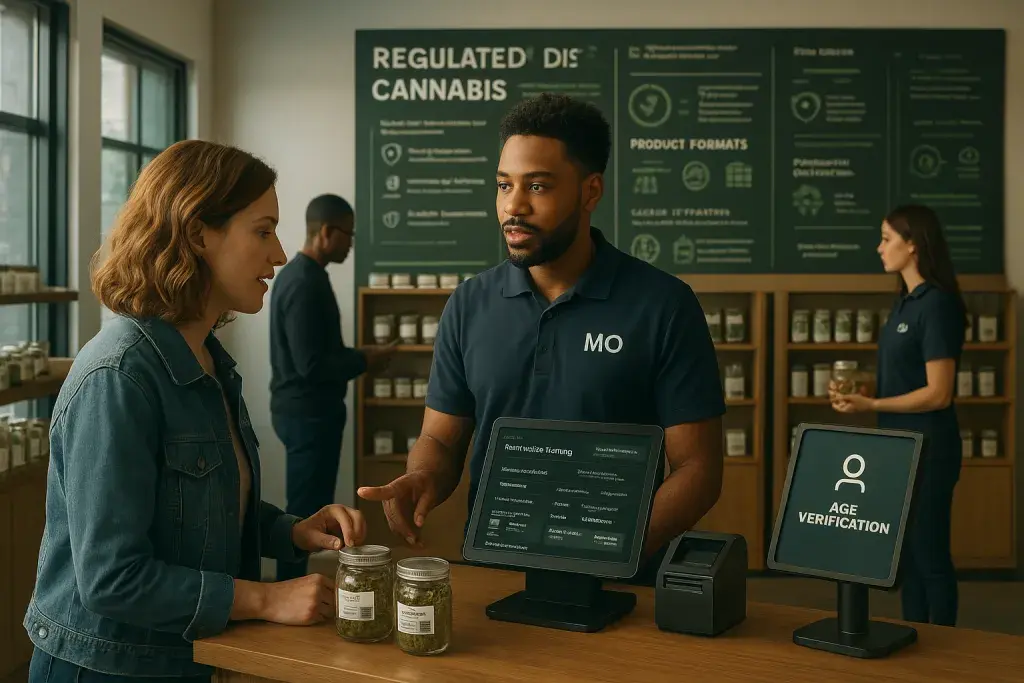
Across legal cannabis markets, the business case for consumer education has quietly become as important as the product mix on the shelf. Dispensary operators and licensed brands that once leaned heavily on promotional messaging are finding that informed customers - ones who understand local regulations, product categories, and responsible purchasing - generate more durable revenue and fewer compliance headaches. The shift isn't philosophical. It's operational.
This matters most in states where regulatory frameworks are still consolidating and consumer expectations are still forming. Missouri, for instance, moved into adult-use sales relatively recently, and operators there have had to build consumer-facing educational infrastructure while simultaneously managing seed-to-sale tracking obligations under the state's Metrc reporting requirements. Retailers using a Metrc-compliant POS for Missouri dispensaries know that back-end compliance and front-end consumer transparency aren't separate problems - they're the same problem, approached from two directions. When inventory data is accurate and reconciled in real time, staff can answer product questions with confidence rather than improvising at the counter.
The broader pattern holds across markets. Operators who invest in staff training, clear labeling explanations, and accessible educational materials tend to see stronger customer retention than those relying on discounting alone. That's not a soft metric. Repeat customers reduce acquisition costs, simplify inventory planning, and generate more predictable wholesale demand signals upstream. Education, in this context, is supply chain strategy as much as it is brand positioning.
Why Transparency Has Become a Compliance Asset
Regulated cannabis retail carries documentation obligations that most other consumer categories don't. Compliant packaging requirements, certificate of analysis availability, age verification protocols, purchase limit enforcement - these aren't optional. Regulators in virtually every adult-use jurisdiction treat consumer-facing transparency as part of the compliance picture, not separate from it.
Here's the catch: operators who treat these requirements as pure administrative burden tend to manage them reactively. Those who treat them as the foundation of a consumer education strategy get more out of the same investment. A COA displayed clearly at point-of-sale isn't just documentation - it's a conversation starter that positions budtenders as credible resources rather than order-takers. That positioning matters when a customer is choosing between two similar SKUs or asking about the difference between product categories.
For multi-state operators managing inventory across several jurisdictions, the complexity compounds. Labeling requirements differ. Purchase limits differ. Tax disclosures differ. A POS system that surfaces jurisdiction-specific compliance parameters at the point of transaction reduces the risk of staff error while simultaneously structuring the customer interaction around factual, legally accurate information. That's not a minor operational detail - it's risk management embedded in the retail experience.
What the Seed-to-Sale Model Demands From Retailers
Seed-to-sale tracking systems like Metrc exist because regulators need a verifiable chain of custody from cultivation through retail sale. For dispensary operators, that means every product batch that hits the sales floor arrives with a transaction ID, a lab-tested potency record, and a documented transfer history. The retail layer - the POS terminal, the inventory count, the sale receipt - is the final node in that chain.
When that node is unreliable, the entire chain is compromised. Inventory shrinkage, reconciliation errors, or manual entry failures don't just create operational friction; they generate compliance exposure. Regulators auditing a dispensary's Metrc logs against its POS records expect those records to match. Discrepancies invite scrutiny. Repeated discrepancies invite enforcement action.
This is why the operational infrastructure conversation and the consumer education conversation are increasingly hard to separate. A dispensary that can't accurately track what it sold yesterday is not in a position to make credible claims about product provenance or responsible retailing today. The back-end data integrity is what gives front-end education its credibility.
Education as a Durable Business Practice in Licensed Retail
The licensed cannabis industry is still working through what adult-use retail actually looks like at maturity. Pricing pressure is real in saturated markets. Wholesale margins have compressed in states where cultivation supply has outpaced retail demand. Against that backdrop, operators are looking for differentiation that doesn't rely solely on price.
Consumer education is one of the few differentiators that compounds over time. A customer who learned something useful during their first visit - about dosing categories, product formats, or local purchase limits - is more likely to return and more likely to ask for staff input on their next purchase. That interaction pattern has downstream effects: it supports higher average transaction values, reduces return-related inventory complications, and generates the kind of word-of-mouth that paid advertising in a restricted-category business simply cannot replicate.
To put it plainly: in a category where conventional marketing channels are limited by state advertising restrictions, editorial-style educational content and well-trained retail staff carry disproportionate weight. Operators who understand that - and build their retail systems around it - are positioning themselves for the kind of customer relationships that survive margin compression. Those who don't are competing on price alone. That's a difficult place to sustain a licensed business long-term.