
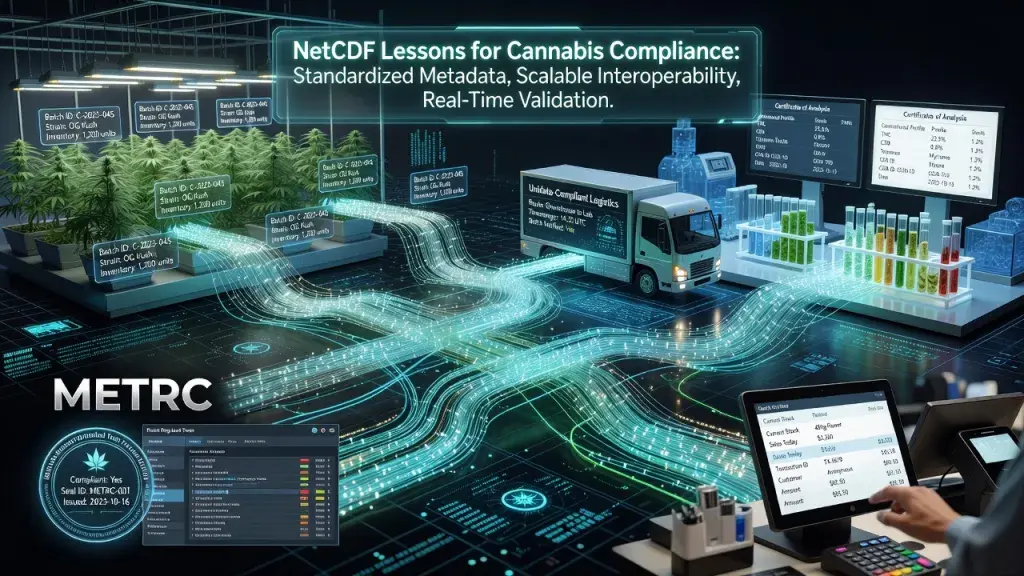
A federal scientific data standard called NetCDF has quietly solved a problem that cannabis operators wrestle with daily: how do you make data trustworthy, portable, and usable across systems that were never designed to talk to each other? NetCDF, maintained by the Unidata Program Center, is a set of software libraries and file formats built to store array-oriented scientific data in a way that any compatible system can read, regardless of how that system stores numbers or text internally. It is not a cannabis technology. But the underlying design problem it addresses is one that every dispensary operator, compliance officer, and seed-to-sale software vendor should recognize immediately.
Why a Data Format Standard Matters to a Regulated Industry
Cannabis retail runs on data that has to move between parties who do not trust each other by default: a cultivator's inventory system, a distributor's manifest, a testing lab's certificate of analysis, a retailer's point-of-sale terminal, and a state's track-and-trace platform such as METRC. Each of those systems was built by a different vendor, often on a different technical foundation. The compliance burden that dispensary owners feel - mismatched batch IDs, delayed manifest uploads, reconciliation errors between wholesale invoices and inventory logs - is fundamentally a data-portability problem. NetCDF's core design principles read almost like a checklist for what regulated cannabis data infrastructure should aspire to.
- Self-describing: a file carries its own metadata, reducing the guesswork that causes compliance logs to fall out of sync.
- Portable: data can move between systems built on different architectures without corruption or loss.
- Appendable: new records can be added without rebuilding an entire dataset, similar to how a daily sales batch should append to inventory history rather than overwrite it.
- Archivable: older data formats remain readable by newer software versions - a real concern for operators facing multi-year record retention requirements under state cannabis law.
The Traceability Gap in Seed-to-Sale Systems
Here's the catch with most commercial seed-to-sale platforms: they were built quickly, under regulatory deadline pressure, and interoperability was rarely the priority. The result is a patchwork where a dispensary's POS system, a distributor's delivery manifest software, and a state's reporting portal each define "batch," "package," or "SKU" slightly differently. That sounds like a minor technical footnote. In practice, though, it produces the exact kind of inventory shrinkage disputes, failed audits, and delayed compliant packaging updates that keep compliance managers up at night. A format designed from the ground up to be machine-independent and self-describing - the way NetCDF is for climate and oceanographic data - would eliminate a category of errors that currently gets handled through manual reconciliation and spreadsheet patchwork.
What Operators and Vendors Should Take From This
Multi-state operators managing dozens of retail locations across different state track-and-trace mandates already know that data standardization saves labor hours and reduces audit risk. The lesson from scientific data management is not that cannabis needs NetCDF itself. It is that durable, sharable, and archivable data formats are a solved engineering problem in other fields, and the cannabis technology sector - still maturing relative to alcohol or pharmaceutical distribution - has room to borrow that thinking. For software vendors serving dispensaries, wholesalers, and testing labs, the priority should be building systems where a lab's COA, a distributor's manifest, and a retailer's compliance log can be verified against each other without manual translation. That is not a regulatory mandate. It is a competitive opportunity, and eventually, a compliance necessity.