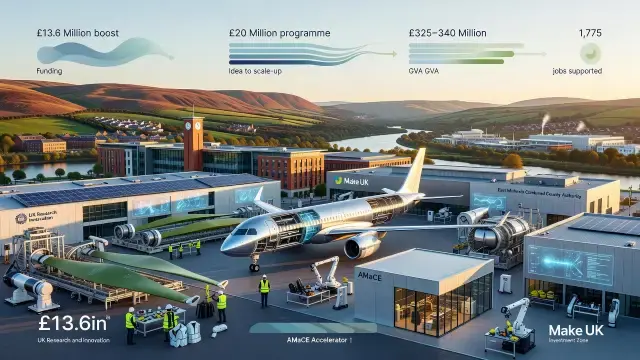
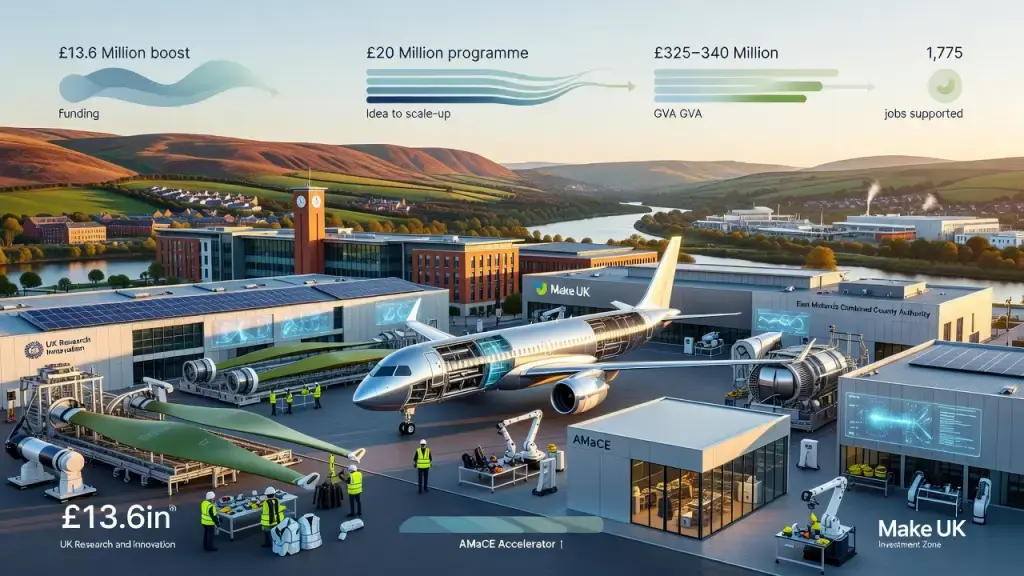
The University of Nottingham will lead three projects within a new £20 million regional programme aimed at turning the East Midlands into a manufacturing base for clean power and propulsion technology. The funding comes from UK Research and Innovation's Local Innovation Partnerships Fund and is coordinated by the East Midlands Combined County Authority, with delivery expected to begin later this year.
What the money actually funds
Call it a pathway, because that's genuinely the design logic here. The programme, Advanced Manufacturing for Clean Energy, is structured so a business can enter at whatever stage fits its needs - early-stage idea, prototype, or scale-up. Nottingham is leading three of the four projects, worth £13.6 million combined, while the University of Derby runs a fourth. Loughborough University and Nottingham Trent University are also involved, alongside industry partners.
The three Nottingham-led strands cover distinct parts of that pathway. The AMaCE Accelerator supports commercialisation - helping start-ups and university spinouts turn research into products that can attract investment. The Next Generation Single-Aisle Hybrid-Electric Propulsion Challenge is more applied: it tests propulsion technologies against requirements set by aircraft manufacturers who are actively choosing systems for the next generation of single-aisle planes. Timing matters there; those manufacturer decisions are happening now, not in some distant future. The third, the Connected Factories Programme, helps regional suppliers adopt digital, automated and lower-carbon manufacturing methods so they can actually produce at scale whatever emerges from the other projects, or elsewhere. This piece also carries an additional £3.2 million from the East Midlands Investment Zone.
Why the East Midlands, specifically
This isn't a cold start. The region already has an established manufacturing cluster serving civil nuclear, aerospace and defence - sectors that demand tight regulatory compliance and long qualification cycles, which tends to build durable supplier ecosystems rather than boom-and-bust ones. Manufacturing makes up 11% of the East Midlands workforce, and according to Make UK, average manufacturing wages there run 21% above the rest of the regional economy. The wider Midlands also hosts the UK's largest aerospace cluster, with roughly 30% of the country's aerospace businesses and over 56,000 jobs. Add to that the government's Fusion Energy Strategy naming the West Burton and Trent Valley area as the UK's second fusion cluster, and the regional pitch starts to look less like boosterism and more like compounding infrastructure.
The economic case, and who benefits
Across the full programme, backers expect £325-340 million in added gross value for the regional economy and support for up to 1,775 jobs, matched by at least £36 million in private investment. Those are programme-level projections, not guarantees - the kind of figures that depend heavily on whether private capital actually follows public seed funding at the pace planned.
What's useful for businesses weighing involvement is the layering. This fund sits alongside the East Midlands Investment Zone's Innovation Accelerator, which backs earlier-stage university-business prototyping work and had its second year confirmed in September. Together they give companies more than one entry point depending on how mature their technology is - a detail that matters more to a small supplier than to a headline figure.
Professor Sir Ian Chapman, UKRI's Chief Executive, said the projects show what happens "when world-leading researchers, innovative businesses and regional partners come together around a shared ambition," adding that they would build on previous UKRI investment to create jobs and deliver benefits across the region.
The programme also formalises something agreed earlier this year: the East Midlands University Compact, signed by EMCCA alongside Nottingham, Nottingham Trent and Derby, committing the partners to joint work on skills, research and inclusive growth. Interested businesses can contact the University of Nottingham directly through its business engagement team to find out where their project might fit in the pathway.