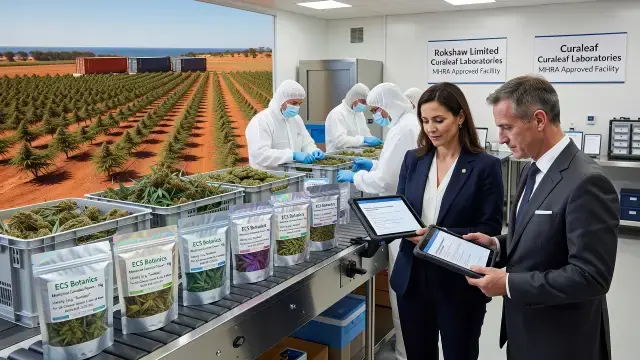
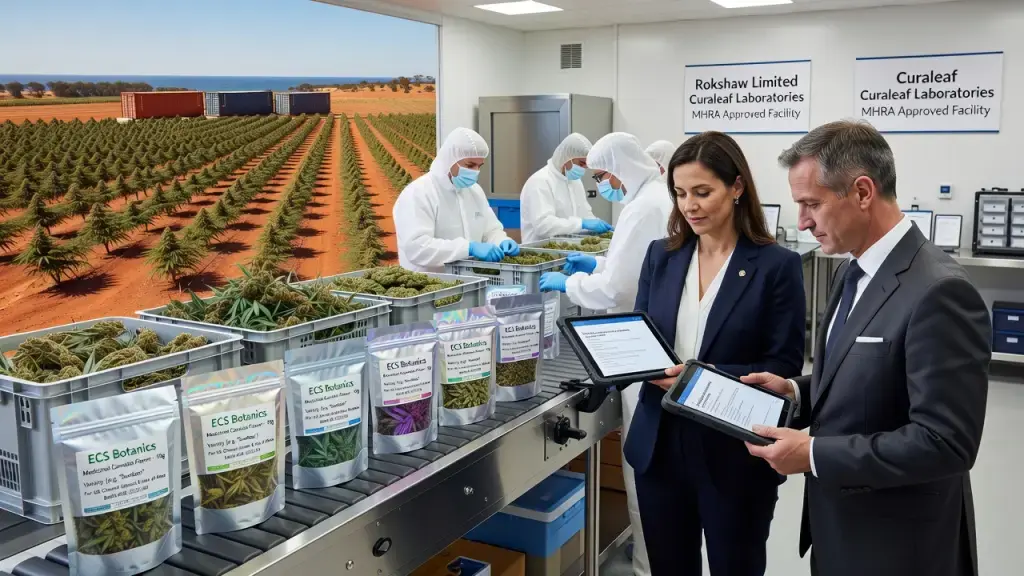
ECS Botanics Holdings Ltd, the ASX-listed Australian cannabis cultivator, has struck a Distribution and Manufacturing Agreement with Rokshaw Limited, trading as Curaleaf Laboratories, to place six ECS-branded medicinal cannabis flower products into the United Kingdom market. The arrangement targets initial supply for November 2026, pending completion of product registrations, import and export permits, and other regulatory sign-offs. It is a cross-border deal that leans heavily on consignment economics rather than upfront purchase commitments - a structure worth unpacking for anyone tracking how Australian cultivators are trying to crack export markets.
How the supply chain actually works
ECS Botanics MC Pty Ltd will grow and supply bulk medicinal cannabis flower from Australia. Curaleaf Laboratories then handles local manufacturing in the UK, converting bulk product into 10g ECS-branded pouches under EU GMP and GDP standards, before distributing through its own and third-party channels. That split matters. Bulk export avoids the cost and complexity of finished-goods packaging crossing borders, while final manufacturing inside the UK keeps labeling, batch testing and compliant packaging under the jurisdiction where the product is actually sold. Curaleaf Laboratories operates an MHRA-approved manufacturing facility, which gives ECS a regulatory anchor it does not have to build itself. The territory covered - the UK, Channel Islands and Isle of Man - is reasonably broad for a single agreement, but it is non-exclusive, meaning ECS is not locked out of parallel deals with other UK-facing partners.
The consignment model, and why it cuts both ways
Here's the part operators and investors should sit with: this is a consignment-based agreement. ECS retains ownership of the product until it is sold by Curaleaf Laboratories or otherwise paid for, and ECS receives an agreed share of net sales price rather than a fixed wholesale rate upfront. That sounds tidy on paper - it aligns ECS's return with actual sell-through rather than just shipping volume. In practice, though, consignment models push inventory risk back onto the supplier. ECS carries the product on its books until it moves, which means working capital sits tied up in UK warehouses rather than converting to cash at the point of export. There are no minimum purchase or revenue commitments in the agreement, and the company has been direct about not issuing revenue guidance as a result. That is a reasonable disclosure position; a non-exclusive deal with no floor is, by construction, unpredictable until real sales data exists.
Term structure and what termination risk looks like
The agreement runs an initial two-year term with automatic renewal for further two-year periods unless terminated. Either party can walk away for convenience after the first anniversary, provided they give at least three months' written notice. That is a fairly standard exit mechanism for distribution agreements of this size, but it is worth noting for anyone assessing counterparty risk: a UK partner with its own portfolio of brands and suppliers is not committing to ECS exclusively, and a twelve-month floor before either side can exit for convenience is not a long runway if execution stumbles.
- Initial portfolio: six ECS-branded Australian-grown medicinal cannabis flower products in 10g pouches
- Commercial model: consignment-based, ECS retains ownership until sold or paid for
- Term: two years initial, auto-renewing, non-exclusive, no minimum volume commitments
- Target initial supply: November 2026, contingent on registrations and import/export permits
Why the timeline matters more than the announcement
The gap between signing and first shipment - roughly a year - is the real story here. Medicinal cannabis exports from Australia to the UK depend on a chain of regulatory approvals: product registration in the destination market, export permits from Australian authorities, import permits on the UK side, and alignment with MHRA manufacturing standards once product lands. Any one of those steps can slip. ECS Botanics Managing Director Nan-Maree Schoerie said the company's near-term focus is completing those registrations and permits ahead of the targeted date, which is the honest way to frame a deal that is signed but not yet operational. Curaleaf International UK Managing Director Jonathan Hodgson framed the partnership around using Curaleaf Laboratories' UK manufacturing, regulatory and supply-chain infrastructure to bring the branded products to market. For dispensary-adjacent and pharmacy-distribution channels in the UK medicinal cannabis space, the practical test will not be the signing of this agreement but whether the registration and permitting pipeline clears on schedule.