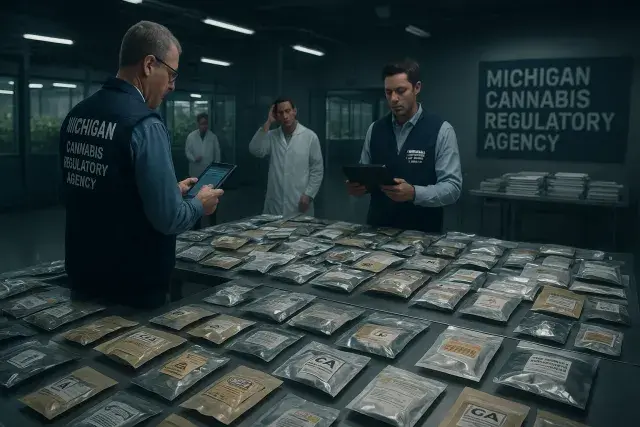
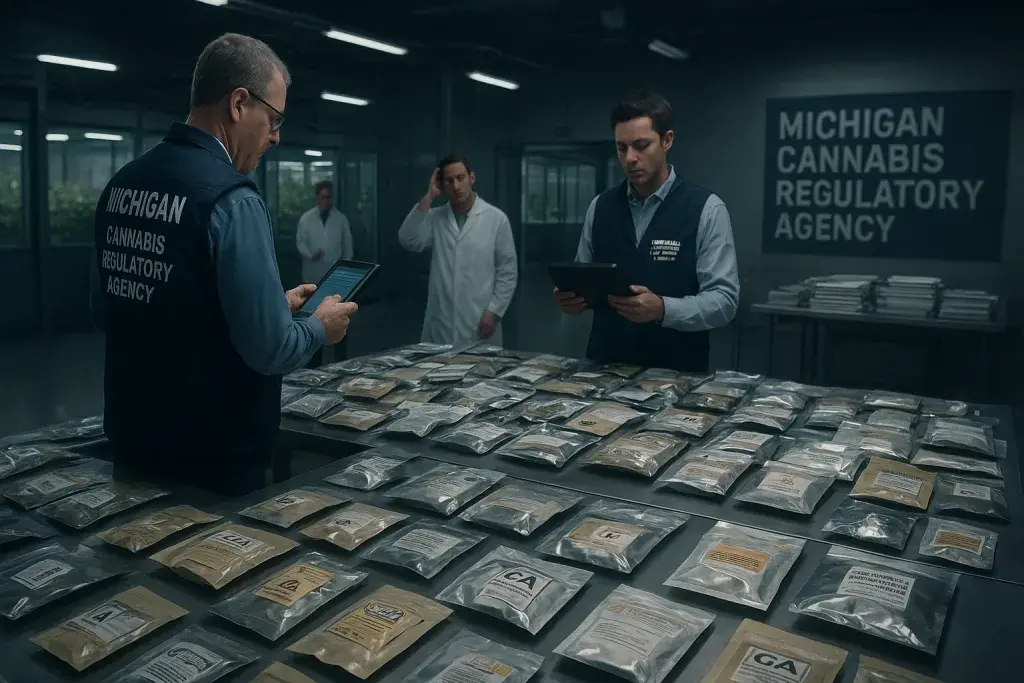
Michigan's Cannabis Regulatory Agency has filed a formal complaint against VJAS 1, a licensed cannabis processor based in Harrison Township, after an inspection uncovered more than 12,000 individual cannabis products with no Metrc tags or other identifying information on site. Among those untagged products were items packaged in California-specific labeling - bearing "CA" designations and California-mandated warning language - which suggested the products originated outside Michigan's licensed supply chain entirely. The company now faces fines and potential license suspension, revocation, restriction, or non-renewal.
The scale of the inventory irregularity is what makes this case stand out. Twelve thousand-plus untracked units isn't a clerical gap or a tagging delay - it's a systemic breakdown of seed-to-sale accountability. Metrc, the track-and-trace platform Michigan and most other regulated states use, exists precisely to prevent this kind of opacity. Every licensed cannabis product in Michigan is supposed to carry a Metrc tag from the moment it's harvested or manufactured through every transfer and point of sale. That's the backbone of the state's compliance framework. Operators in other regulated markets - from operators using a cannabis dispensary pos new york system to processors in Michigan - understand that inventory without proper tagging is, in regulatory terms, inventory that doesn't exist. The fact that VJAS 1 employees could not explain the presence of those products only compounds the agency's concern.
The California packaging detail deserves its own attention. Regulated cannabis states maintain strict residency requirements for their supply chains; licensed product cannot legally cross state lines, full stop. Federal law classifies cannabis as a Schedule I controlled substance, which means interstate cannabis commerce - even between two legal states - remains a federal violation. When inspectors find product bearing another state's consumer warning language inside a Michigan processing facility, the implication isn't ambiguous. That product either entered the facility through an unlicensed channel, or something went badly wrong in how inventory was sourced, labeled, or stored. Investigators also found that several products carrying valid Metrc tags were cross-referenced in the system as belonging to entirely different licensed businesses - a separate, serious discrepancy suggesting either misappropriation of tags or wholesale record manipulation.
What Metrc Failures Actually Signal
Seed-to-sale tracking failures don't just create compliance exposure - they undermine the foundational argument that licensed cannabis markets can self-regulate effectively. The entire regulatory compact between state governments and licensed operators rests on traceability: the idea that every unit can be accounted for, tested, taxed, and traced back to a licensed source. When a processor carries thousands of untagged products, those units have no chain of custody. They haven't necessarily been lab-tested. There's no COA on file. Consumers, retailers, and regulators have no way to verify potency, contamination status, or origin. That's a consumer safety issue as much as a compliance one.
For other licensed Michigan operators, the enforcement action is a reminder of how severely track-and-trace lapses are treated at the agency level. A license is not just a permission slip - it's a revocable authorization contingent on continuous compliance. Processors and retailers who treat Metrc tagging as a bureaucratic formality rather than an operational control tend to accumulate the kind of inventory discrepancies that attract exactly this kind of scrutiny. The stakes here are clear: VJAS 1 is facing the full range of administrative penalties, up to and including permanent license revocation.
Broader Implications for Licensed Cannabis Operations
This case reflects a pressure point that compliance professionals across regulated markets understand well. Cannabis supply chains involve multiple handoffs - cultivator to processor, processor to distributor, distributor to retailer - and each transfer point is a moment where tagging integrity either holds or breaks down. A product that enters a facility without a proper Metrc tag should, in theory, never make it past receiving. The fact that thousands of units apparently did - including products bearing another state's packaging - points to either a failure of receiving protocols, deliberate circumvention, or both.
The cross-referenced tags are worth noting separately. If investigators found tags on products that Metrc showed as physically located at other licensed businesses, that means tags were either transferred improperly or duplicated - neither of which happens accidentally in a well-run operation. It also raises questions about the integrity of those other businesses' inventory records. The CRA is likely to follow that thread.
For operators at every tier of the supply chain, the practical takeaway is straightforward: regular internal audits of physical inventory against Metrc records aren't optional housekeeping. They're the difference between catching a discrepancy before a regulator does and finding out about it after a formal complaint is filed. The gap between those two outcomes - in legal exposure, operational disruption, and license risk - is significant.