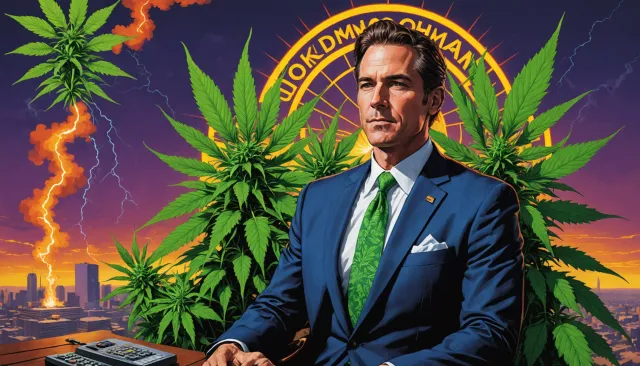

An Oklahoma attorney general running for governor also chairs a bank whose growth tracks almost perfectly with the state's medical cannabis industry - the same industry his office is charged with policing. That overlap, sitting in public FDIC filings and on the bank's own leadership page, is now a live issue in Tuesday's Republican runoff, not a hypothetical one raised by opponents looking for an angle.
Blue Sky Bank, chaired by Attorney General Gentner Drummond, has grown from roughly $200 million in assets in 2018 to more than $1.3 billion today, a run that began the same year Oklahoma voters approved medical marijuana under State Question 788. The bank markets a "Canna-Direct" account and armored cash pickup to growers, processors, dispensary owners, transporters, and testing labs across nearly 30 states - infrastructure that exists because federal law still keeps most traditional banks out of cannabis entirely. For comparison, operators in states without that kind of dedicated cannabis banking infrastructure often lean on retail technology instead, the way a dispensary running marijuana point of sale minnesota software might reconcile daily cash drawers against METRC data just to stay audit-ready. The gap Blue Sky Bank fills is real. Whether the bank's chairman should also control the prosecutorial machinery deciding who counts as a legitimate cannabis operator is a separate question entirely. marijuana point of sale minnesota
Why Cannabis Banking Is Still a Cash Problem
To understand why this matters operationally, it helps to remember what cannabis banking actually solves. Because marijuana remains federally illegal, most national banks and card networks avoid touching cannabis money, leaving dispensaries and cultivators to stack cash in safes or pay premium fees to niche institutions willing to take the risk. A bank offering compliant cannabis deposit accounts, armored transport, and reporting aligned with the Bank Secrecy Act fills a genuine market gap. That is not, by itself, improper. Plenty of community banks around the country have built cannabis-focused verticals the same way, layering in enhanced due diligence, transaction monitoring, and currency transaction reporting to stay on the right side of federal guidance.
The friction here is not that Blue Sky Bank serves cannabis clients. It is that Drummond simultaneously holds discretionary power to seize and dismiss local prosecutions, a power he has exercised more than once, while chairing the institution that profits from the industry those prosecutions touch. Unverified claims about structured cash deposits and cross-border cannabis transport remain unverified - no documents, routes, or names have surfaced publicly. But the appearance problem does not require proof of wrongdoing to be real. It requires only that the public cannot easily separate the regulator from the beneficiary.
What Rescheduling Could Mean for Cannabis Balance Sheets
The stakes are about to grow. The Justice Department's move to reschedule marijuana to Schedule III would end the crushing 280E tax penalty that has long forced state-licensed operators to pay income tax on gross revenue rather than net profit. For multi-state operators and community banks alike, that shift could free up meaningful capital - money that flows directly into deposit growth at institutions built around cannabis banking. A gubernatorial candidate whose own bank stands to benefit from that policy shift owes voters a plain answer about what it means for his family's financial stake, not silence.
The Disclosure Standard Voters Should Expect
- Independent audit of Blue Sky Bank's cannabis-related deposit growth and compliance controls
- Public accounting of family board and advisory roles tied to cannabis banking revenue
- Clear separation, in writing, between prosecutorial discretion and personal financial interest
- Disclosure of how federal rescheduling would affect the bank's cannabis deposit base
None of this requires taking anonymous sourcing at face value. It requires the kind of transparency any regulated cannabis operator would be expected to produce on demand - compliant packaging logs, lab testing records, seed-to-sale tracking data. If cannabis retailers must document their entire chain of custody for a regulator's inspection, a regulator asking to lead the state should be able to document his own.