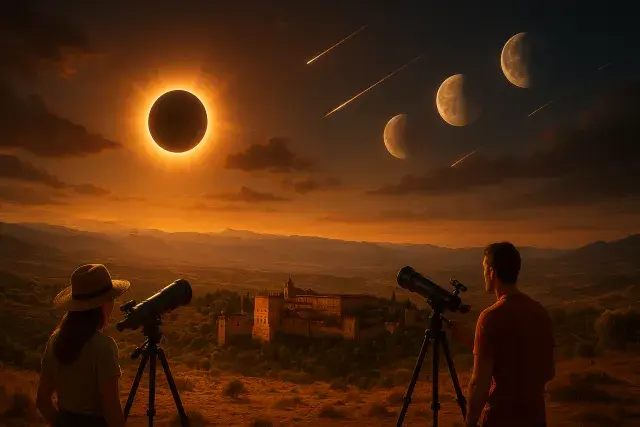
Summer officially began across the Northern Hemisphere this Sunday at 10:24 a.m., bringing with it what Spanish meteorologists are describing as the season's probable first heat wave - temperatures running well above seasonal norms for much of the country. The 2026 summer season will last approximately 93 days and 16 hours, ending September 23 with the astronomical start of autumn, according to Spain's National Astronomical Observatory (OAN).
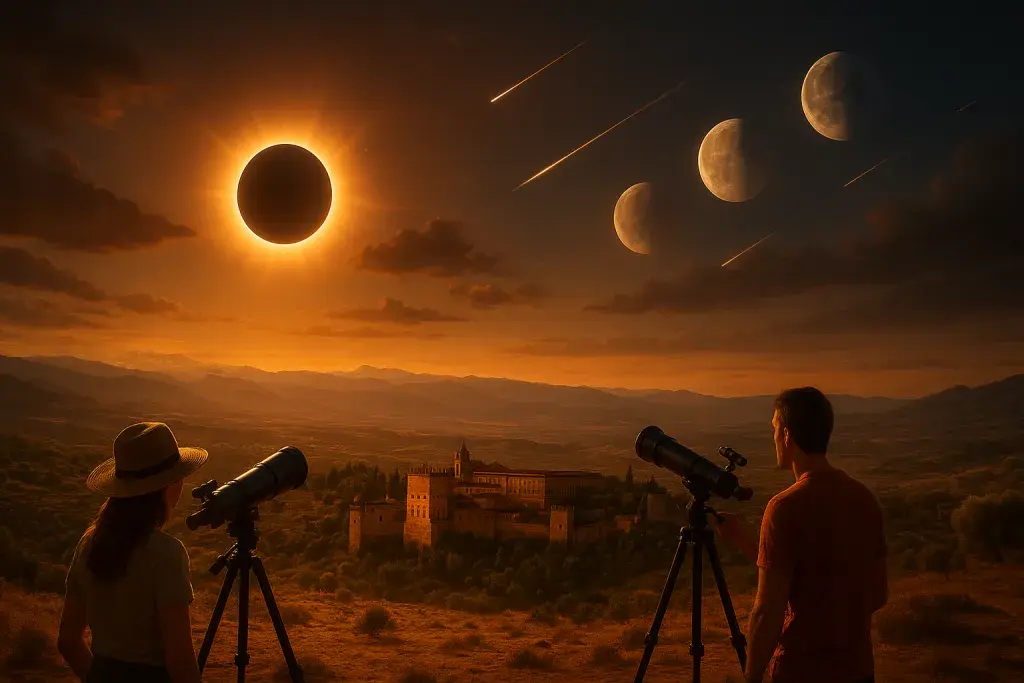
Beyond the heat, the season carries a notable astronomical calendar. Two eclipses will be visible from Spain in August - a total solar eclipse on August 12, observable from the Arctic, Greenland, Iceland, the northern Atlantic, and from Spain just before sunset; and a partial lunar eclipse on August 28, with a high magnitude, visible across all of Spain before moonset, though in central and eastern parts of the Iberian Peninsula and the Balearic Islands the moon may set before the eclipse phase concludes. For businesses that track consumer behavior across seasonal peaks - retail operators in warm-climate markets, for instance, including those relying on cannabis pos software nevada to manage inventory and transaction flow through high-traffic summer periods - this kind of extended daylight and event-driven foot traffic tends to shape demand patterns in measurable ways.
Three full moons will occur within the season: June 29, July 29, and August 28. The delta Aquariid meteor shower reaches its peak around July 31, followed by the Perseids on August 13 - one of the most observed meteor events of the year in the Northern Hemisphere.
Solstice Mechanics and What the Calendar Actually Shows
The June solstice marks the longest day of the year for the Northern Hemisphere. For the central Iberian Peninsula, that translates to 15 hours and 3 minutes of daylight on the solstice - compared with just 9 hours and 17 minutes on the winter solstice, the shortest day. That gap of nearly six hours represents the outer boundaries of Spain's annual solar cycle.
On July 6, Earth reaches aphelion - the point of maximum annual distance from the Sun, at just over 152 million kilometers. That's roughly 5 million kilometers farther than perihelion, which occurred on January 3. The counterintuitive implication is worth a moment's pause: summer in the Northern Hemisphere happens when Earth is actually farthest from the Sun. The season's heat is driven by axial tilt and the angle of incoming solar radiation, not by proximity to the star itself.
Heat, Storms, and a Busy Observational Calendar
Spain's State Meteorological Agency (AEMET) spokesperson Rubén del Campo characterized the opening conditions as consistent with what could become the season's first official heat wave. Heat and storms are both expected to feature prominently in the coming weeks - a combination that defines early summer across much of the Iberian Peninsula.
The full astronomical picture for the season is, by any measure, unusually rich: two eclipses, three full moons, two significant meteor showers, and an aphelion - all within a 93-day window. For amateur astronomers and general audiences across Spain, August in particular stands out as a month worth watching carefully, with the total solar eclipse on the 12th and the partial lunar eclipse on the 28th bracketing the Perseid peak on the 13th.