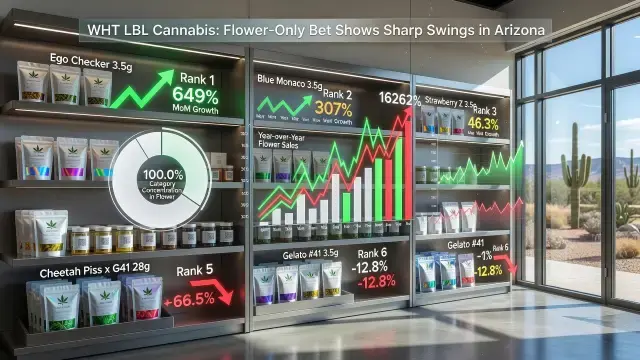
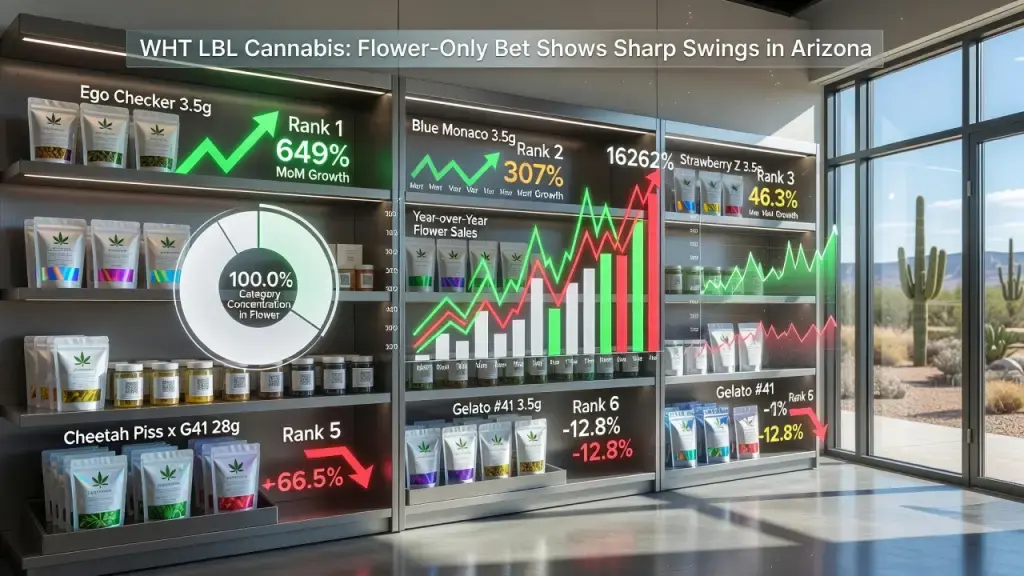
A single-category cannabis brand just posted the kind of numbers that make wholesale buyers sit up and procurement teams ask harder questions. WHT LBL Cannabis (White Label) ran 100.0% of its September 2026 Arizona business through Flower, with year-over-year Flower sales climbing 16262.75% even as the month-over-month figure slipped 3.08%. Average price dropped 39.89% year-over-year to $11.90, while total brand sales rose 6334.996% over the same period - a gap between volume growth and price compression that tells its own story about how this label is competing.
One Category, All the Exposure
Here's the catch with a 100.0% category mix: there's no cushion. A multi-category brand can absorb a soft month in Flower with a strong run in vapes or edibles. WHT LBL Cannabis (White Label) doesn't have that option. Every swing in Flower pricing, every shift in SKU-level demand, hits the brand's entire revenue line at once. That's not inherently a bad strategy - plenty of value-tier operators build a business around a tight assortment and a lean SKU count - but it does mean rank volatility and sales volatility move in lockstep. The 3.08% month-over-month dip after a triple-digit-plus annual run reads less like weakness and more like a normalization after a period of rapid distribution gains, the kind that happens when a brand lands on more wholesale menus and more POS terminals in a short window, then settles into a steadier baseline.
Price Compression and the Value Play
A 39.89% year-over-year decline in average price, landing at $11.90, paired with triple-digit sales growth, points toward a volume-led model rather than a margin-led one. In practice, this is a familiar pattern in adult-use Flower: as cultivation capacity expands and wholesale pricing softens across a maturing state market, brands that lean into lower price points can still grow total revenue if unit velocity rises faster than price falls. That's what appears to be happening here. The risk for operators carrying this brand on their shelves is straightforward - thin margins on compliant packaging, testing, and excise tax obligations leave less room for error if velocity ever stalls. For dispensary buyers, that math matters as much as shelf appeal.
Rank Movement Tells a Longer Story
WHT LBL Cannabis (White Label) sits at #38 in Arizona Flower for September, a one-place improvement from #39 in June but a steep drop from its #17 peak in May. That five-month arc - climb, then slide - suggests an initial surge in distribution or SKU count that outpaced what sustained demand could support. Compare that to the top of the board: Just Flower has held #1 year-over-year, Find. moved from #3 to #2 on 56.6% YoY growth, Loud Pax jumped from outside the top 50 to #5 on 2,181.5% YoY growth, and Mohave Cannabis Co. held a top-three spot with steadier 6.0% YoY growth. The contrast is instructive. Brands consolidating the top ranks are showing either sustained dominance or explosive, newly-arrived demand - not the post-peak cooling WHT LBL Cannabis (White Label) appears to be working through.
SKU-Level Shifts Favor Smaller Formats
Within the brand's own Flower lineup, the SKU data points to a format pivot worth watching across the category broadly. Ego Checker (3.5g) jumped 649% month-over-month to rank 1, and Blue Monaco (3.5g) followed with a 307% rise to rank 2. Strawberry Z (3.5g) climbed 46.3% to rank 3. Meanwhile, bulk and shake-adjacent formats lost ground - Cheetah Piss x G41 (28g) fell 66.5% to rank 5, and Gelato #41 (3.5g) slid 15.5% to rank 6. With eighths anchoring three of the top six positions and Flower SKUs filling eight of the top ten slots, the pattern suggests consumers and budtenders are gravitating toward smaller, higher-velocity pack sizes rather than bulk ounces - a shift that resets rank faster and rewards brands that can keep fresh batches moving through testing and onto dispensary shelves quickly.
What This Means for Buyers and Compliance Teams
For multi-state operators and independent dispensaries stocking this brand, the lesson isn't about one label's fortunes - it's about what single-category concentration does to forecasting. Store managers building wholesale menus should treat a 100.0% Flower mix as a flag for tighter inventory shrinkage monitoring and more frequent COA review, since any batch-level testing delay or compliant-packaging hiccup has outsized effect on a brand with no other category to fall back on. Regulators and seed-to-sale trackers aside, the practical takeaway is this: value-priced Flower brands can grow fast in a maturing market, but that growth tends to be fragile unless it's backed by either genuine product differentiation or diversification beyond a single category.