
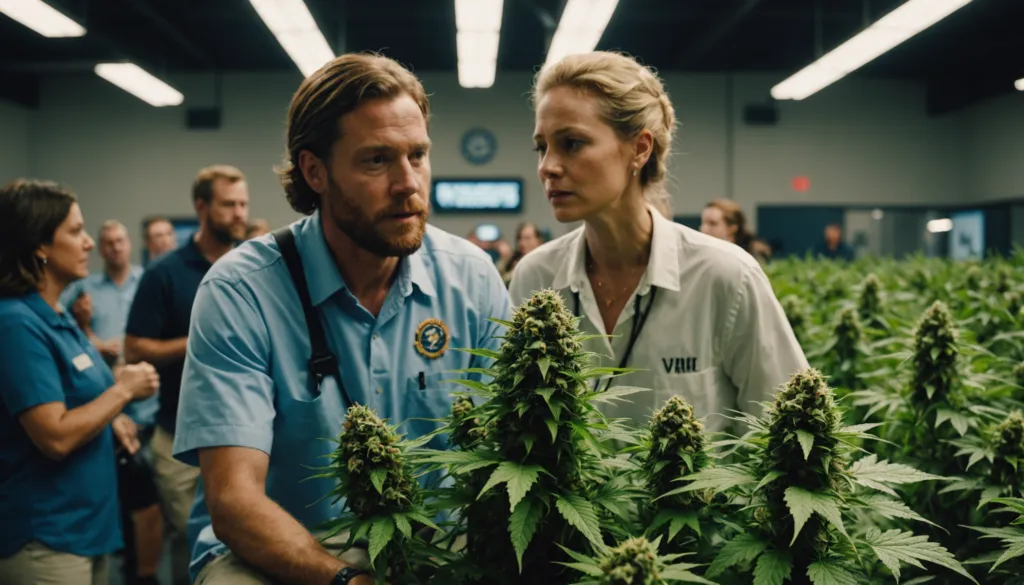
Virginia's General Assembly has cleared a regulated adult-use cannabis marketplace through the state's biennial budget, with licensed retail sales targeted to begin July 1, 2027 - if Gov. Abigail Spanberger signs the legislation. The compromise passed with strong margins in both chambers, ending a prolonged standoff that earlier this year saw Spanberger veto a standalone cannabis market bill over concerns about tax structure, launch timing, and enforcement provisions. The industry now waits on one signature - and the clock is already running for operators who need to plan for a commercial market that's still far from certain.
What the Framework Actually Establishes
The approved structure is fairly specific in its parameters. Adults 21 and older could purchase up to 2 ounces per transaction - double the current 1-ounce possession limit - through licensed retail stores or delivery services. The Virginia Cannabis Control Authority would oversee licensing, with the total retail footprint capped at 350 stores statewide. That cap matters. In other regulated markets, license caps have shaped everything from wholesale pricing leverage to real estate competition between operators. States that opened with hard caps - and later lifted them - saw significant price compression downstream. Virginia operators watching this framework should factor that ceiling into their build-out and acquisition calculus from day one. For context, operators in markets like Oregon, where licensing eventually expanded well beyond early projections, know that point-of-sale infrastructure built for scale proved far more durable than systems scoped for a controlled rollout; tools like cannabis pos software oregon operators relied on had to absorb rapid regulatory and volume changes that nobody fully anticipated at launch. Virginia's cap provides some near-term certainty, but it won't last forever if the market performs.
The Tax Structure and What It Means for Dispensary Economics
The tax math here is worth walking through carefully. At launch, adult-use sales would carry a 6% state excise tax on top of existing Virginia sales taxes. That excise rises to 8% on July 1, 2029. Local governments can layer on up to an additional 3.5%. Add it together and some operators in certain localities could face a combined state-and-local excise burden approaching 11.5% before standard sales tax is applied.
That's not unusually punitive by national standards, but it's not trivial either - particularly for operators trying to price competitively against the illicit market while covering compliance costs, testing fees, compliant packaging, seed-to-sale tracking overhead, and the standard operational weight of retail cannabis. Margins in adult-use dispensaries tend to compress over time as markets mature and competition increases. Virginia operators would be entering a market where the tax structure gets more expensive two years in, right around when competitive pressure typically accelerates.
The existing medical marijuana operators - currently licensed under Virginia's medical program - face a different calculation. They can enter the recreational market through a licensing conversion process, but the price of admission is a $10 million fee. That is a substantial capital requirement. It effectively means the early recreational retail tier will be dominated by operators with significant balance sheets, at least at the outset. Smaller or independent prospective entrants will be watching the licensing conversion path closely to understand whether meaningful new license categories emerge that don't carry that same entry cost.

Compliance Posture and the Penalty Shift
One underreported element of this framework is the increase in civil penalties for public marijuana consumption. The current $25 fine - frankly, not much of a deterrent - rises to $250 under this legislation, effective July 1, 2027, concurrent with the retail market launch. That timing is deliberate. Regulators in other states have learned that standing up a retail market without reinforcing public-consumption rules creates enforcement headaches and hands critics a ready-made narrative about disorder. Virginia appears to be threading that particular needle intentionally.
For dispensary operators, that enforcement posture has a secondary implication: compliance training for budroom staff becomes more important, not less, as the retail market opens. Responsible retailing practices - age verification protocols, transaction limits, compliant labeling and packaging, POS-system-enforced purchase caps - are the front line of defending a license. A $250 public consumption fine signals that Virginia intends to hold the regulatory environment to a visible standard. Operators who treat compliance as overhead rather than infrastructure tend to find out the hard way how quickly a license review can reshape their business.
Revenue Allocation and the Broader Policy Signal
The budget language directing cannabis tax revenue toward early childhood education, behavioral health services, public health, and the Cannabis Equity Reinvestment Fund tracks a pattern seen in several other adult-use states - using cannabis revenue to address both general budget priorities and communities historically affected by drug enforcement. That's a political architecture as much as a fiscal one. It creates stakeholders beyond the cannabis industry itself who have an interest in the market succeeding.
The hemp provision is also worth noting. Narrowing the definition of legal hemp products and transferring hemp regulation to the Cannabis Control Authority signals an intent to reduce the regulatory arbitrage that hemp-derived cannabinoid products have exploited in states with separate, weaker hemp oversight. For licensed dispensaries, that's generally a competitive improvement - it reduces the shelf presence of unregulated analogues sold in convenience stores and online without the testing, labeling, and compliance requirements that licensed operators must meet.
Virginia's adult-use market has been closer to reality than it has appeared for years. Now there is a signed framework moving toward a governor's desk. Whether Spanberger signs it, amends it, or once again redirects it will determine whether 2027 actually becomes year one - or another placeholder on a timeline that keeps shifting.