A new peer-reviewed study suggests that Germany's rapidly expanding medical cannabis market is behaving less like a clinical supply chain and more like a consumer retail market - one where price and potency, not therapeutic indication, are driving purchasing decisions. Published in late June in the International Journal of Drug Policy by researchers from German and Danish universities, the findings raise pointed questions about whether the country's post-reform medical cannabis framework is serving patients or quietly absorbing recreational demand through a medical channel.
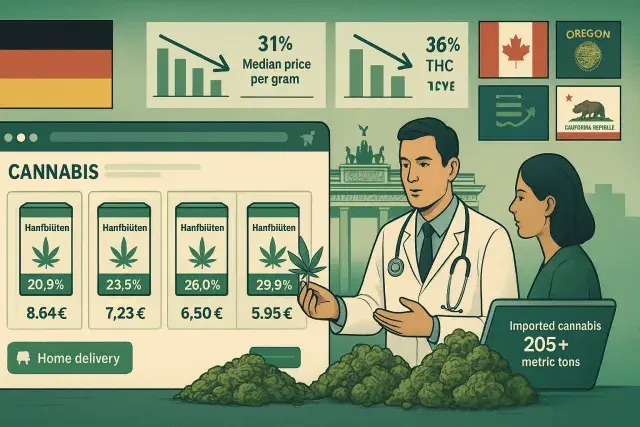
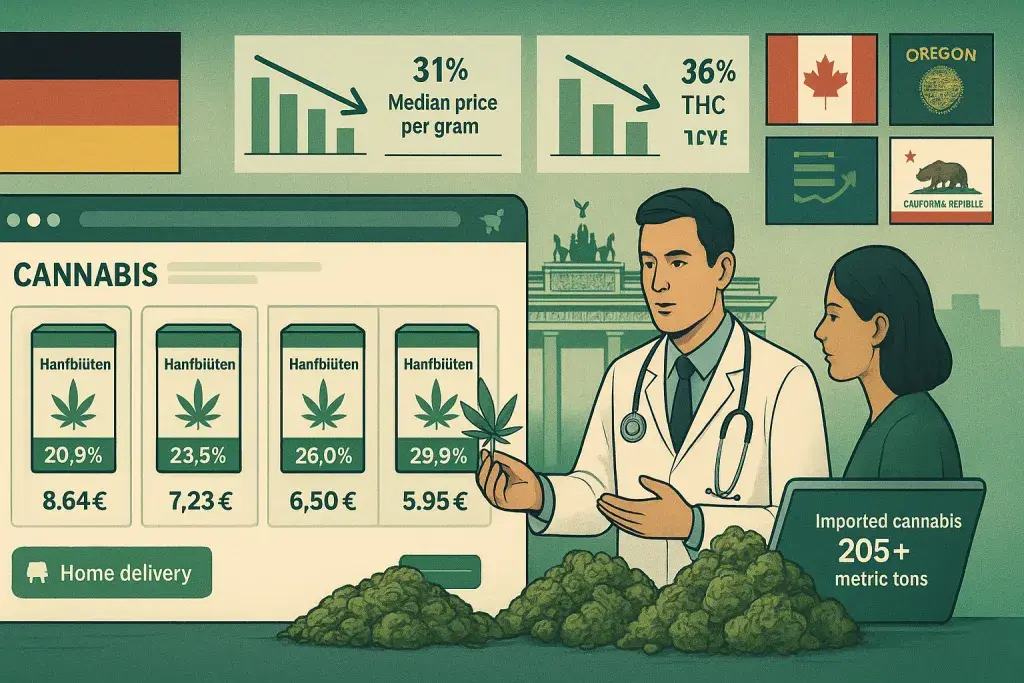
The study tracked sales data from a single German online medical cannabis dispensary over a 12-month period between December 2024 and November 2025, collecting roughly 24 million observations via web-scraping methods and retaining approximately 6.5 million data points covering 996 distinct cannabis flower products. The numbers tell a clear directional story: median price per gram fell 31%, from €8.64 to €5.95, while the cost per 10 mg of THC dropped 36%, from €0.37 to €0.23. THC levels, meanwhile, climbed from around 23% to 26%. Products in the 20-29.9% THC range accounted for more than two-thirds of sales. Lower-potency flower - under 15% THC - attracted minimal consumer interest. Operators tracking comparable market dynamics in mature adult-use markets, where the price-potency relationship has reshaped wholesale menus and SKU prioritization, can learn more about how similar consumer behavior unfolded as competition intensified and margins compressed.
Here's the catch: clinical evidence for medical cannabis is largely built on studies using extracts or low-THC flower, often containing less than 10% THC, with recognized indications limited to conditions such as non-cancer pain, spasticity, and chemotherapy-induced nausea. High-THC cannabis flower - the category now dominating German online dispensary sales - has not demonstrated proven benefits for those or other conditions, and carries documented mental health risks. The researchers were direct: "The availability and demand of high-potency cannabis flower are not consistent with available evidence for cannabis being a remedy for health problems." They also concluded that "a substantial share of the rising demand is attributable to non-medical use of cannabis."
How Germany's 2024 Reform Opened the Market - and the Compliance Gap
Germany's 2024 cannabis reform removed medical cannabis from the country's list of narcotic drugs, a reclassification that significantly simplified prescribing. It also legalized limited recreational possession and home cultivation, and authorized cannabis social clubs - but stopped well short of permitting commercial adult-use retail sales. The effect, in practice, was a hybrid market: a legal recreational framework with no commercial sales channel, sitting alongside an increasingly accessible medical system now operating through telemedicine platforms and online dispensaries offering home delivery.
That combination produced the boom the study documents. Telemedicine made prescriptions faster and easier to obtain. Online dispensaries competed aggressively on price. The number of products listed on the tracked platform rose from 266 in December 2024 to 401 by November 2025. Germany imported more than 205 metric tons of medical cannabis in 2025, compared with roughly 62 tons in 2024, according to the country's Federal Institute for Drugs and Medical Devices - a more than threefold increase in a single year. In the first quarter of 2026, imports reached 50.5 tons, up from 37.6 tons in the same period the prior year. Germany is now the largest medical cannabis market in Europe, with Prohibition Partners estimating its value at nearly $997 million in 2025.
What the reform did not build was a robust gatekeeping infrastructure. Without mandatory in-person evaluations, there is no structural mechanism distinguishing a patient with a documented clinical need from a recreational user seeking a legal, medically labeled supply. That is the compliance gap regulators are now looking at directly.
Market Dynamics That Will Be Familiar to North American Operators
The trajectory Germany is on is not new. Canada saw it. Multiple U.S. states saw it. As regulated cannabis markets mature, product variety expands, competition drives down wholesale and retail prices, and consumer preference consolidates around high-potency, value-priced SKUs. It happened in Oregon, Colorado, California. In each case, the market dynamics outpaced the regulatory framework's ability to enforce clinical or public health boundaries - particularly where product selection is driven by point-of-sale consumer behavior rather than prescriber guidance.
What is different in Germany is that the market carrying this behavior is technically medical, not adult-use commercial retail. That matters for compliance professionals and policymakers because it means the public health obligations attached to a medical channel - clinical appropriateness, prescriber accountability, dispensing oversight - are being stress-tested against consumer behavior more typical of recreational retail. The researchers noted that their findings are consistent with broader patterns in Canada and the United States as those markets expanded.
Regulatory Pressure Is Already Building
Germany's government is reportedly proposing stricter rules that would require in-person physician visits for cannabis flower prescriptions and mandate pharmacy pickup rather than home delivery. If enacted, those changes would structurally reverse much of what made the current telemedicine-and-delivery model so accessible - and so commercially successful.
For operators and investors watching Germany as a model for European medical cannabis market development, the policy direction carries real business implications. Tighter prescribing requirements would compress patient volumes at the top of the funnel. Mandatory in-person dispensing would eliminate the delivery-only model that online dispensaries have built their operations around. Product selection pressure would likely shift if prescribers - operating under greater regulatory scrutiny - began favoring lower-THC, evidence-backed formulations over the high-potency flower that currently dominates sales.
The broader question the study surfaces is one that regulators in every cannabis market have eventually faced: when commercial incentives and consumer preferences diverge from public health intent, which one does the regulatory framework actually enforce? In Germany right now, that answer is not yet settled - but the direction of travel is becoming clearer.