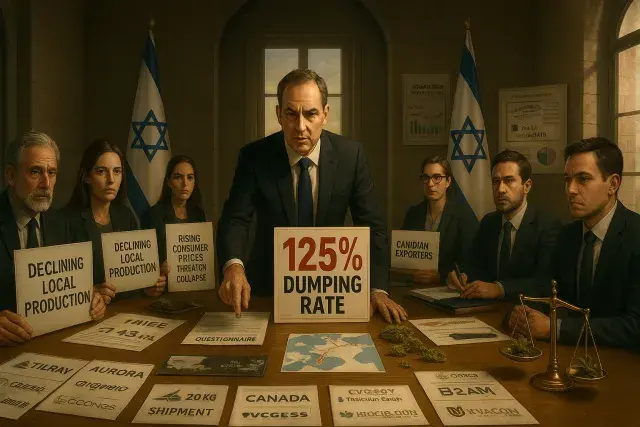
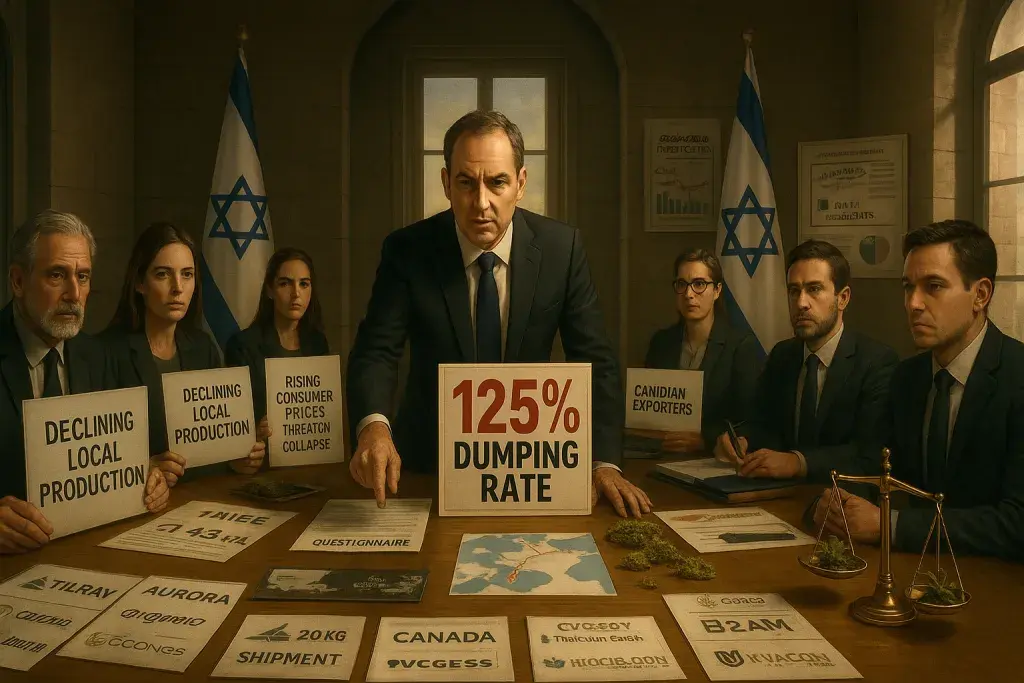
Israel's Commissioner for Trade Levies, Danny Tal, has launched a new anti-dumping investigation targeting Canadian medical cannabis exporters - less than six months after a District Court rejected Israeli growers' bid to impose import tariffs. The new complaint, filed May 28, 2026, by domestic producers Evergreen Solomon Pharma Ltd. and Trichome Ltd., argues that market conditions have shifted materially: local production is declining, consumer prices are rising, and the Israeli cultivation industry is edging toward what the complainants describe as collapse. The investigation covers alleged dumping activity from January to December 2025.
The named companies include some of Canada's most recognized cannabis exporters - Tilray, Aurora, Organigram, Cronos Group, Canopy Growth, Pure Sunfarms, Avant Brands, Hexo Corp, Decibel, Rubicon Organics, and BZAM. It's worth keeping this list in context: these are established, publicly traded operators with compliance infrastructure and international trade experience, not fringe market actors. For cannabis businesses tracking international trade dynamics - from operators using dispensary software in Ohio to wholesale procurement teams managing multi-country supply chains - the scope of this investigation signals how aggressively domestic producers in regulated markets are now willing to use trade law as a competitive tool.
The core allegation rests on pricing math. Commissioner Tal's document cites a dumping rate of approximately 125%, calculated as the gap between what Canadian exporters charge Israel - roughly 4.43 NIS per gram (approximately $2.10 CAD) - and what the document argues is the prevailing domestic Canadian market price, estimated at approximately 10 NIS per gram (roughly $4.76 CAD). Exporters and importers have 30 days to respond to a questionnaire, with submissions due by July 29, 2026. Non-compliance carries a meaningful consequence: decisions may be made based on "best available information," a standard that historically does not favor unresponsive parties.
The Structural Argument Behind the Complaint
What makes this investigation more textured than a simple price dispute is the structural critique embedded in the complaint. The Commissioner's document flags the rise of "constructive importers" - entities that bring cannabis into Israel without maintaining local growing infrastructure - and a shift in import patterns toward high-volume, small-batch shipments, such as packages of 20 kg carrying a wide variety of strains. The implication is deliberate market fragmentation: by flooding pharmacies with diverse SKUs and small, flexible quantities, importers can serve patient preferences in ways that vertically integrated local producers, optimized for consistent large-batch output of a limited strain catalog, simply cannot match.
That's not a new dynamic in regulated cannabis markets. It mirrors what has played out repeatedly in adult-use retail environments, where wholesale menus with deep strain variety and rapid turnover put pressure on producers whose business models assume longer production cycles and stable off-take agreements. Here, the stakes are framed differently - because Israel's medical cannabis system serves licensed patients, not recreational consumers. There are currently 426 pharmacies licensed to sell medical cannabis in Israel, and active patient registrations peaked at 140,483 in January 2024 before declining to approximately 129,900 by March 2025. Flower-based products account for over 94% of usage. The complainants - who say they represent roughly 80% of domestic growers not engaged in imports - argue that import pressure is undermining the supply continuity those patients depend on.
A Regulatory History That Keeps Circling Back
This is the second investigation in roughly eighteen months. The first began in November 2024, when Commissioner Tal found evidence of dumping causing material harm and recommended tariffs as high as 165% on certain Canadian companies. The Advisory Committee endorsed those findings in March 2025. The Minister of Finance rejected the tariff idea. A June 2025 ruling from Israel's Legal Advisor to the Prime Minister appeared to close the book on the debate. And yet here we are again - new complaint, new investigation, same underlying tension.
That cycle tells you something. The political and legal machinery in Israel has, so far, consistently blocked the imposition of tariffs. But domestic producers have found in trade law a durable instrument for applying pressure, generating regulatory uncertainty, and potentially deterring new import arrangements even when formal levies never materialize. For Canadian exporters, the practical risk isn't just a future tariff - it's the compliance burden of responding to multiple overlapping investigations, the reputational friction of being named in government documents, and the operational uncertainty that makes long-term supply agreements harder to price and negotiate.
What Canadian Exporters and Their Partners Should Watch
The July 29 questionnaire deadline is not a formality. Anti-dumping proceedings in most jurisdictions - Israel included - allow investigators to substitute their own assumptions for missing data when respondents don't engage. Companies that exported to Israel during the January-to-December 2025 period named in this complaint need to assess their exposure and respond with properly documented pricing data, cost structures, and market analysis. The previous investigation's recommended tariff of up to 165% on specific companies suggests the Commissioner's office is willing to reach aggressive conclusions when it finds the evidence warranting.
The broader signal here is that export-dependent cannabis supply chains are not insulated from the same trade-law pressures that govern steel, textiles, or agricultural commodities. Cannabis is maturing into a global commodity business - and with that maturity comes the full weight of international trade regulation, including anti-dumping mechanisms that were never designed with cannabis in mind but apply to it regardless. For Canadian producers, Israel has been a meaningful export market. Whether it remains one may depend less on product quality or patient demand and more on how the next round of submissions, legal arguments, and ministerial decisions play out.