
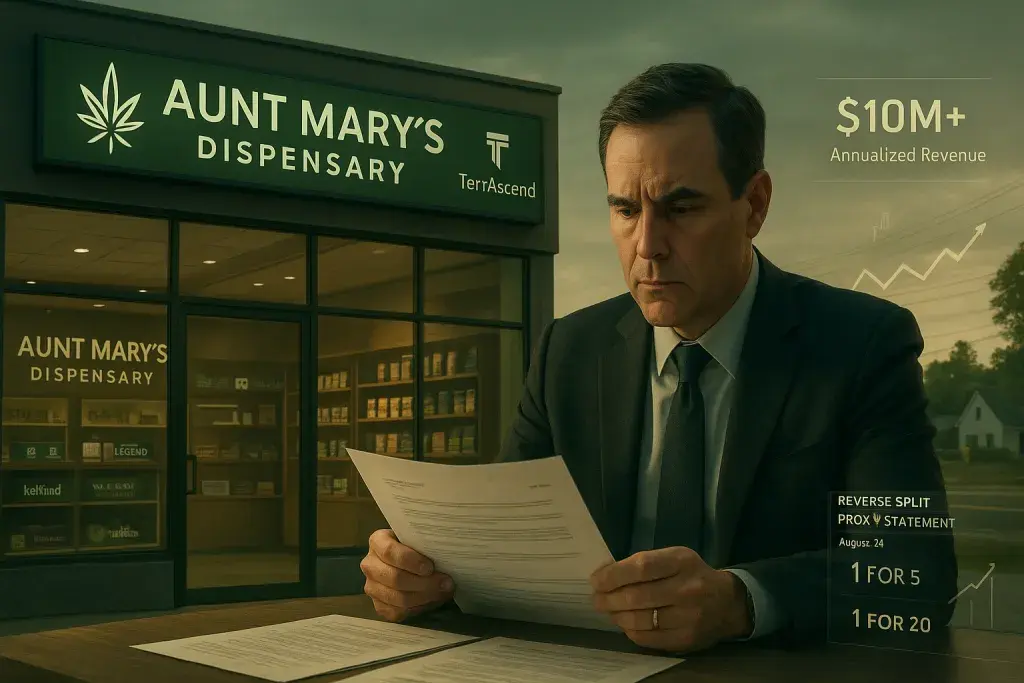
TerrAscend Corp. is expanding its New Jersey retail footprint and pushing toward a potential uplisting to a major U.S. stock exchange - two moves that, taken together, signal where the company sees its near-term growth. The company announced an option agreement to acquire Aunt Mary's Dispensary LLC in Flemington, New Jersey, a Hunterdon County operation generating more than $10 million in annualized revenue. Separately, TerrAscend filed a preliminary proxy statement with the SEC calling a special shareholder meeting for August 24, where shareholders will be asked to approve a share consolidation intended to satisfy minimum price requirements on major U.S. exchanges.
The Flemington deal is structured as a phased option. TerrAscend will pay $3 million via a five-year unsecured convertible promissory note at 6% interest for the right to acquire a 35% stake in Aunt Mary's, with an additional $6 million in cash due if the option is exercised - bringing the total purchase price to $9 million. The company says the transaction is expected to be immediately accretive on both an EBITDA and free cash flow basis. For operators tracking how multi-state operators are building density within high-performing state markets, it's worth understanding how retail consolidation strategies are evolving across the Northeast - you can learn more about how adjacent regulated markets are developing similar retail dynamics. Closing on the Aunt Mary's deal remains subject to regulatory approval, as is standard for cannabis license transfers in New Jersey.
Aunt Mary's opened in February 2023 and operates from a 5,200-square-foot retail space in what TerrAscend describes as a high-traffic corridor with limited nearby competition. That last detail matters. New Jersey has been deliberate - and at times slow - in issuing adult-use retail licenses, which means established dispensaries in underserved counties can maintain meaningful revenue without the margin compression that comes from a saturated local market. Hunterdon County isn't Bergen or Middlesex; it's a less densely served area where a well-run dispensary can hold pricing power. At over $10 million in annualized revenue from a single location, Aunt Mary's is performing well above what many single-site operators achieve.
Vertical Integration as a Margin Play
TerrAscend's executive chairman, Jason Wild, made the company's operational thesis explicit: the margin opportunity lies in vertical integration and brand introduction. TerrAscend intends to push its house portfolio - Kind Tree, Legend, Valhalla, and Cookies - into Aunt Mary's retail mix. That's a familiar playbook for multi-state operators. When an MSO acquires or absorbs a dispensary, wholesale margin that previously went to third-party cultivators and processors can be recaptured internally. The POS data from that location also feeds back into the MSO's broader merchandising and inventory strategy.
In practice, though, vertical integration in cannabis isn't frictionless. New Jersey's regulatory framework governs how licensed cultivators and processors supply to retail, and any change to product sourcing must track through the state's seed-to-sale system. SKU transitions on dispensary shelves require compliant packaging, updated COAs, and accurate inventory reconciliation - details that matter both for state compliance and for maintaining consumer trust at the point of sale. The operational lift is real, even when the financial case is clean.
The Share Consolidation and the Uplisting Argument
The shareholder meeting scheduled for August 24 is where TerrAscend's capital markets strategy comes into focus. The company is asking shareholders to approve a share consolidation - a reverse split, in plain terms - with the board retaining discretion to set the ratio anywhere between one-for-five and one-for-twenty, and to execute within 12 months of approval. The stated purpose: meet minimum share price thresholds required by major U.S. stock exchanges.
TerrAscend already checks several boxes that cannabis companies typically lack when pursuing exchange listings. Its financials are prepared under U.S. GAAP. Its shares are registered with the SEC. It trades on the OTCQX. What it needs is a per-share price that clears the floor set by major exchanges - hence the consolidation proposal. Wild's framing was direct: "We believe uplisting to a major U.S. exchange is no longer a question of if, it is a question of when."
That confidence isn't baseless, but it is conditional. The federal regulatory environment around cannabis has been shifting - rescheduling discussions have advanced further than at any previous point - but a major exchange listing for a cannabis company with U.S. plant-touching operations still requires either a change in federal law or exchange-level policy decisions that haven't yet been formalized. TerrAscend is positioning itself to move fast when that window opens. Whether the window opens on the company's preferred timeline is a separate question entirely.
What This Means for the Broader Operator Class
For dispensary owners and multi-state operators watching from the outside, this deal and proxy action together illustrate a specific growth posture: asset-light retail expansion paired with capital markets preparation. The option structure on Aunt Mary's limits TerrAscend's upfront cash exposure while securing access to a revenue-generating location. That's a sensible approach in a capital environment that remains constrained for cannabis businesses - traditional financing is still largely unavailable, and equity dilution carries real cost.
The 280E tax burden hasn't disappeared. Cannabis businesses operating federally scheduled operations still face the prohibition on standard business deductions that makes profitability harder to achieve at scale. An uplisting, if it comes, won't resolve that. What it would do is broaden TerrAscend's investor base, improve liquidity, and potentially lower the cost of future capital raises - advantages that matter when you're building a multi-state retail network one location at a time.
Shareholders of record as of June 30 are eligible to vote. The proxy voting deadline is 1 p.m. Eastern on August 20.