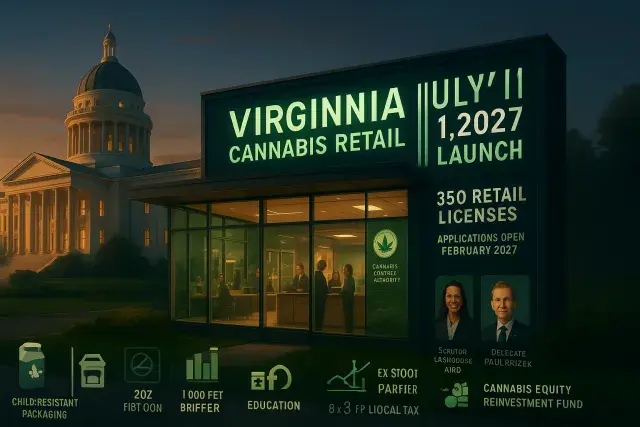
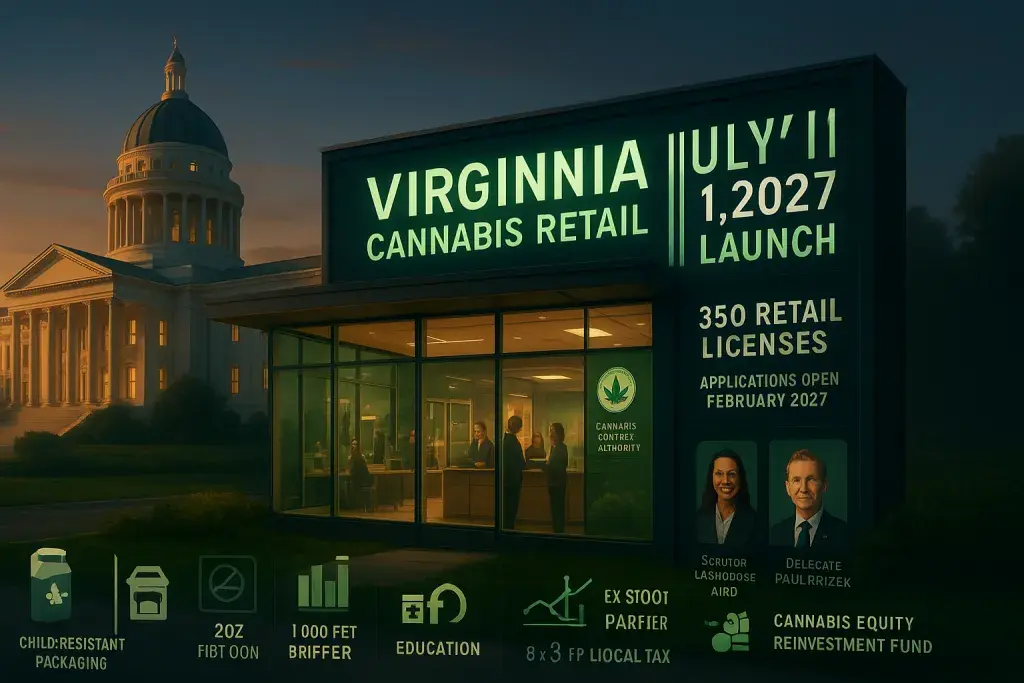
Virginia is closer to a functioning adult-use retail market than it has ever been. Gov. Abigail Spanberger announced a compromise proposal this week alongside Sen. Lashrecse Aird and Del. Paul Krizek that would open licensed recreational cannabis sales on July 1, 2027 - pushing back a previously proposed January 2027 start date to give the Cannabis Control Authority time to build a workable regulatory infrastructure. Two bills from the 2026 Regular Session were vetoed by Spanberger in May; this agreement represents a renegotiated framework that both the executive and legislative branches appear willing to support.
The six-month delay is more than a calendar adjustment. Spanberger framed the extended timeline as necessary for the CCA to develop testing and safety standards, establish licensing processes, and construct an oversight framework that won't buckle under the pressure of a live market. Operators who have watched other state launches stumble - product shortages, compliance bottlenecks, enforcement gaps - will recognize the logic. States that rushed their adult-use rollouts have often spent years cleaning up the consequences. That said, the delay also extends the period during which the illicit market continues to operate without meaningful competition from licensed retailers. It's a tension that every regulated cannabis market faces, and Virginia won't be immune to it. Operators and vendors already active in states with established frameworks - including those supplying marijuana pos software alaska retailers - know that the gap between legalization and a fully operational retail environment is where compliance infrastructure either gets built correctly or gets built twice.
The licensing structure gives the market a defined ceiling: a maximum of 350 retail cannabis establishment licenses, with the CCA beginning to accept applications on February 1, 2027. For context, that number is described in the proposal as comparable to commercial markets in other states - though operators and investors will want to watch how the CCA distributes those licenses across the commonwealth's varied geography. Three hundred fifty licenses spread across urban corridors, suburban counties, and rural localities is a very different market than the same number clustered in Northern Virginia and Richmond. License caps of this kind directly shape real estate strategy, competitive density, and wholesale pricing dynamics. Multi-state operators assessing Virginia's entry potential should be running those calculations now, not in late 2026.
Tax Structure and the Revenue Allocation Framework
The tax architecture here is worth reading closely. The proposal sets a state excise tax rate of 6 percent at launch, with a scheduled increase to 8 percent after July 1, 2029. Localities can layer on an additional 1 to 3.5 percent local tax, combined with the existing retail sales and use tax. That means the effective tax burden on a retail sale could vary meaningfully depending on where a dispensary operates - a factor that matters for pricing strategy, wholesale cost modeling, and competitive positioning against unlicensed sellers.
The phased tax increase is a deliberate policy choice: keep rates low enough at launch to pull consumers away from the illicit market, then raise them once licensed retail has established footing. That's a reasonable theory. In practice, though, the success of that transition depends heavily on how quickly the CCA can license and supply enough retail locations to give consumers a genuine alternative. Revenue from cannabis sales will be directed toward early childcare and education, K-12 education, behavioral health and substance use disorder programs, public health programs, and the Cannabis Equity Reinvestment Fund - the latter established under 2021 legislation to address disparities in communities disproportionately affected by past enforcement. The fund supports scholarships, workforce development, small business growth, and reentry services.
Compliance Requirements Operators Need to Understand Now
The proposal includes a set of consumer safety and compliance provisions that will shape how retail operations are structured from day one. Key requirements include:
- Child-safe packaging requirements and prohibitions on cartoon advertisements
- Bans on products shaped like animals, fruits, vehicles, or humans
- Retail locations must be no less than 1,000 feet from schools, hospitals, playgrounds, and drug treatment facilities
- Escalating penalties for failed ID checks, up to and including license revocation for repeated underage sales
- Possession limit raised from 1 ounce to 2 ounces
- Transfer of industrial intoxicating hemp regulation from the Virginia Department of Agriculture and Consumer Services to the CCA - closing the 25:1 hemp loophole
The 1,000-foot buffer requirement will constrain real estate options, particularly in dense urban areas. Dispensary operators and their real estate advisors need to begin site analysis well before the application window opens in February 2027. The hemp loophole closure is equally significant: products that have been legally sold through VDACS oversight will come under CCA authority, which means testing requirements, labeling standards, and licensing obligations that currently don't apply to those products will. That's a compliance transition with real operational cost.
One Remaining Variable: The Budget
Here's the catch - none of this is finalized yet. The retail cannabis market is being established as part of Virginia's broader budget process, and that budget is currently stalled over disagreements on data center tax incentives. The Senate is scheduled to vote on June 22 ahead of a June 30 deadline. If the budget process drags past that window without resolution, the cannabis framework embedded within it faces uncertainty. Operators, investors, and vendors watching Virginia from the outside would be wise to treat this as near-final, not done. The regulatory and business infrastructure - POS system procurement, compliance software evaluation, real estate analysis, equity license strategy - should be in planning stages. But capital deployment waits for signatures.
Virginia's path to retail has been longer and more contentious than most. Two vetoes, years of competing proposals, and a governor who ultimately drove the compromise from the executive branch rather than accepting what the legislature sent her - that's an unusual dynamic, and it has produced a framework that reflects executive priorities as much as legislative ones. Whether that produces a tighter, more durable market or a more constrained one will depend on how the CCA interprets its mandate over the next eighteen months. That implementation phase is where the real work begins.