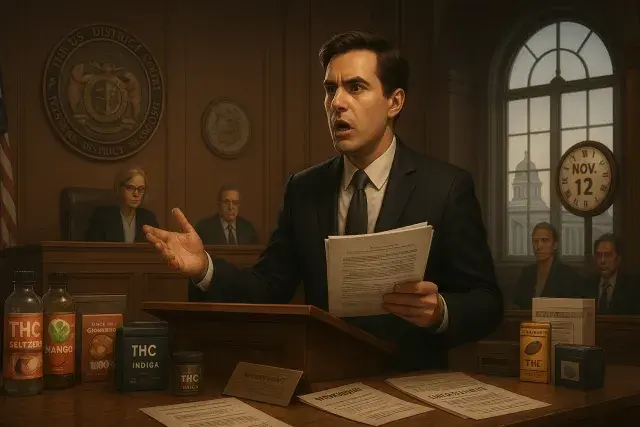
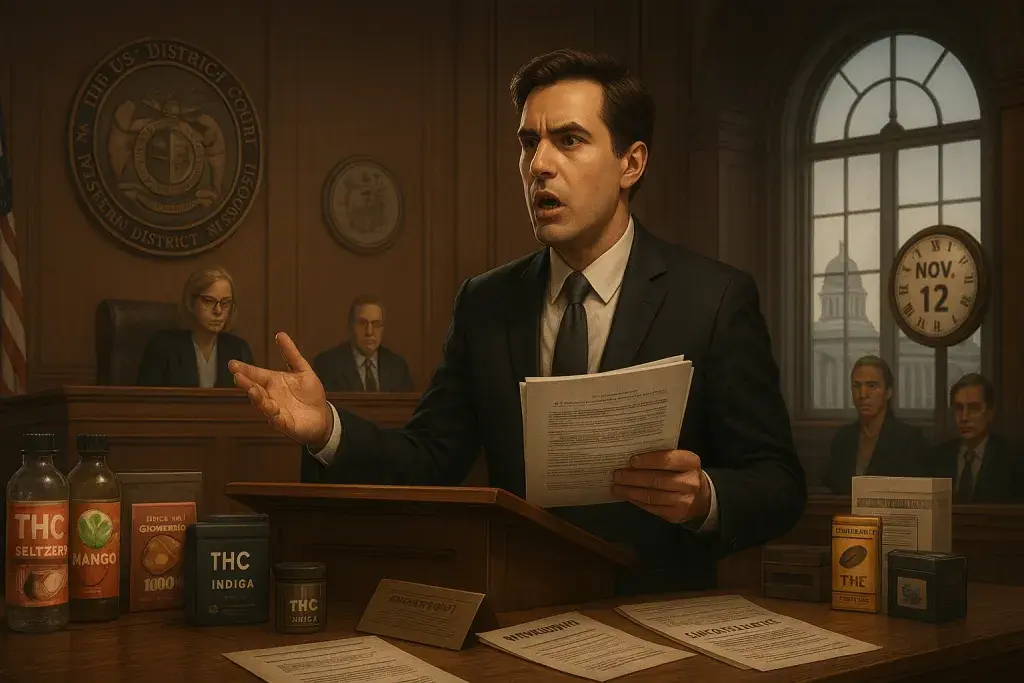
A coalition of hemp companies filed a federal lawsuit Thursday in the U.S. District Court for the Western District of Missouri, seeking to stop a statewide ban on intoxicating hemp products from taking effect November 12. The legislation - House Bill 2641, signed this spring by Gov. Mike Kehoe - would remove THC-infused seltzers, edibles, and related products from grocery store shelves, bars, and smoke shops across the state. For the businesses that built supply chains and retail footprints around these products, the clock is now running on either a court injunction or a forced exit from the market.
The coalition includes MNG 2005, Inc. - parent company of the 55 CBD Kratom retail chain - the Missouri Hemp Trade Association, and Wisconsin-based Lifted Liquids Inc. Their core legal argument is pointed: the bill defines the same products as both "hemp" and "marijuana" in separate provisions, creating definitional conflict that they say renders the statute unconstitutionally vague. For any licensed business trying to maintain compliance, that kind of statutory ambiguity is not a technical nuisance - it is an operational emergency. Compliance managers rely on precise statutory language to build internal controls, train staff, audit SKUs, and determine what can legally sit on a shelf. Tools like IndicaOnline dispensary software are built to map products to legal classifications, but when those classifications are internally contradictory, no software system can resolve the underlying legal exposure for operators caught in the middle.
Craig Katz, government relations and compliance manager for MNG 2005, put it plainly: lawmakers drafted this legislation without a firm grasp of how the cannabis supply chain actually works. That's not an unusual problem - hemp and marijuana regulatory frameworks have overlapping chemistry, divergent federal and state definitions, and a compliance structure that most general-practice legislators encounter only briefly before voting. The result, Katz argues, is a bill that doesn't track the industry it's meant to govern. HB2641 also restricts who may transport hemp products through Missouri, raises questions about its effect on interstate commerce, and contains effective-date provisions the coalition describes as too convoluted for businesses to parse into actionable compliance timelines.
What the Law Actually Does - and Where It Gets Complicated
HB2641 was designed to align Missouri state law with the federal hemp ban Congress approved last year. That alignment logic is straightforward enough on paper: if the federal government bans intoxicating hemp-derived products, Missouri will too. But the bill goes further. Even if Congress reverses course and permits these products, Missouri would restrict sales to licensed marijuana dispensaries - removing them entirely from the general retail channel where they currently move significant volume. And if Congress simply delays its ban for a couple of years, Missouri's law would still prohibit all intoxicating hemp products except for beverages.
The enforcement authority under the bill falls to Missouri Attorney General Catherine Hanaway. That matters because, as the coalition's filing notes, unlicensed marijuana activity is a criminal offense in Missouri - not a civil infraction. If prosecutors and law enforcement officers are working from a statute that defines the same product as both hemp and marijuana, those criminal exposure questions don't resolve themselves neatly. The coalition argues businesses cannot determine with any certainty which products are covered, which are not, and when each provision applies. That's a compliance environment most licensed operators would find untenable regardless of their position on the underlying policy.
The Broader Market Pressure Behind the Lawsuit
Missouri's situation reflects a tension playing out across multiple states. Because the 2018 Farm Bill created a legal federal pathway for hemp-derived cannabinoids, a large secondary market developed outside state-licensed marijuana retail systems - selling products with meaningful THC concentrations through smoke shops, convenience stores, and general merchandise retailers. In Missouri, products containing as much as 1,000 mg of THC were sold in smoke shops without the licensing, lab testing mandates, or compliant packaging requirements that apply to products sold inside licensed dispensaries.
That's the political context Rep. Dave Hinman, the bill's sponsor, is working from. His position is that HB2641 gives state law enforcement the tools to enforce the coming federal ban - and that the lawsuit amounts to a last-ditch effort to preserve a market that the federal government has already moved to close. "Missouri will mirror the federal government," he said. Fair enough as a policy argument. But the coalition's concern isn't with the policy goal - it's with the statutory drafting. Vague definitions in criminal law create real risk for businesses that are trying to comply, not circumvent.
What Operators and Retailers Should Watch
For licensed marijuana dispensary operators in Missouri, the outcome of this lawsuit carries its own set of implications. If HB2641 survives legal challenge and takes full effect, intoxicating hemp products disappear from general retail - potentially redirecting some consumer demand toward licensed dispensaries, where adult-use and medical cannabis products are already subject to testing, potency verification, and compliant packaging requirements. That's a meaningful structural shift in where regulated cannabis retail sits relative to the broader market.
The coalition's claim that non-intoxicating CBD products could also be swept off shelves by vague definitions adds another layer. If that reading has merit, the compliance fallout would extend well beyond THC beverages and edibles - reaching a product category that many retailers, pharmacies, and wellness stores have carried without controversy. Missouri courts and, ultimately, regulators will have to clarify where those lines fall. Until they do, any business with hemp-derived products in its inventory should be reviewing its legal exposure against the statute's actual language - not waiting for an enforcement action to answer the question.