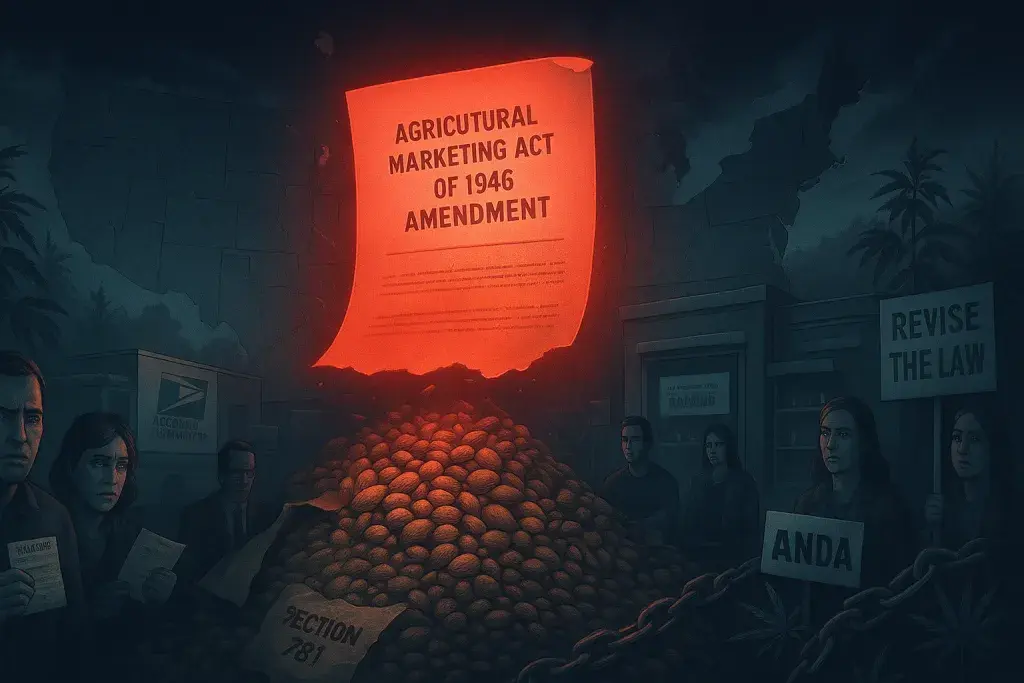
A single section buried in a federal spending bill is about to upend how cannabis seeds move through American commerce. The FY2026 Agriculture Appropriations Act, signed into law in November 2025, redefines hemp under the Agricultural Marketing Act of 1946 in a way that excludes viable cannabis seeds derived from plants exceeding 0.3% total THC. That change, set to take effect November 12, 2026, does not target finished intoxicating products alone - it reaches back into the genetic supply chain that every cultivator, breeder, and seed company depends on.
Here's the catch operators need to understand: seeds themselves carry effectively no THC. A seed is not a smokable product, not an edible, not a vape cartridge. Yet under Section 781, a seed's legal status will hinge on the THC concentration of the parent plant that produced it - not on anything measurable in the seed itself. That's a traceability problem most seed companies were never built to solve, and it lands at the same moment operators across the supply chain are already managing seed-to-sale tracking, COA documentation, and state-by-state compliance logs. For multi-state operators juggling licensing across different regulatory regimes, from cultivation permits to retail systems like cannabis pos utah, this adds another layer of federal-state friction to an already fragmented compliance environment.
Why This Reaches Far Beyond Seed Companies
Dispensary operators and cultivators tend to think of seed law as someone else's problem - a niche concern for breeders and genetics firms. It isn't. Retail cannabis, medical and adult-use alike, depends on a pipeline of plant genetics that starts with seed companies, moves through licensed cultivators, and ends up on budroom shelves as flower, pre-rolls, and extracts. If seed commerce collapses - banking access disappears, shipping carriers refuse packages, payment processors cut off merchant accounts - the upstream genetic diversity that supports cultivar development narrows sharply. Fewer available genetics means fewer differentiated products, less competitive wholesale menus, and, over time, consolidation around whichever entities control patented or proprietary genetic lines.
That last point deserves attention from anyone running a retail operation. If seed access becomes restricted to a small set of licensed, well-capitalized genetics holders, cultivation costs shift accordingly, and those costs move downstream to wholesale pricing and eventually to the consumer. Home cultivation rights, where they currently exist, could also come under renewed pressure, since a law that criminalizes seed sale makes personal cultivation functionally impossible even where state law permits it.
The Compliance and Banking Fallout
Section 781's mechanics create a strange asymmetry. A seed testing at 0% THC could still be treated as a Schedule I substance if it cannot be traced to a compliant parent plant. That's not a theoretical compliance gap - it's the kind of ambiguity that examiners, banks, and payment processors respond to by simply exiting the relationship rather than sorting out the nuance. Financial institutions already skittish about cannabis-adjacent accounts under 280E pressures and inconsistent federal guidance are unlikely to extend any benefit of the doubt to seed and breeding businesses. Expect merchant account terminations, cashless payment disruptions, and shipping carriers such as USPS declining seed packages outright, regardless of THC content.
What Operators and Suppliers Should Watch
- Whether Congress or USDA issues clarifying guidance before the November 2026 effective date
- How seed companies pivot - clones, tissue culture, and novelty-seed workarounds carry their own legal fragility
- Potential loss of landrace and heirloom genetics with agricultural or research value
- Increased consolidation risk among cultivators dependent on a shrinking pool of legally tradable genetics
Advocacy groups such as the American Seed Innovation and Growth Alliance are pushing for legislative revisions before the deadline, but industry response so far has been fragmented rather than unified. For dispensary operators, wholesalers, and cultivators, the practical takeaway is straightforward: a policy change framed as an anti-intoxicant measure is quietly reshaping who gets to control cannabis genetics - and that is very much a retail and supply chain issue, not just a breeder's concern.