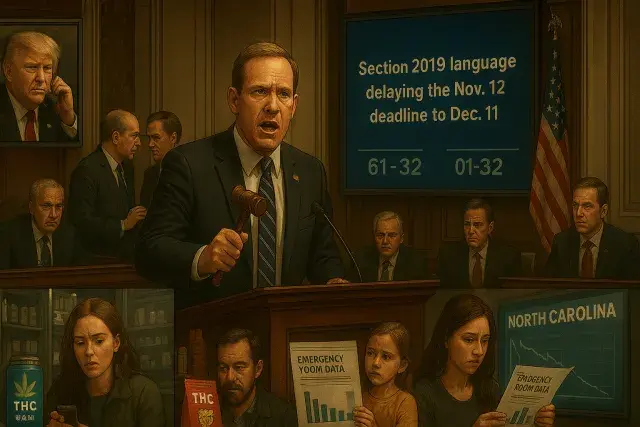
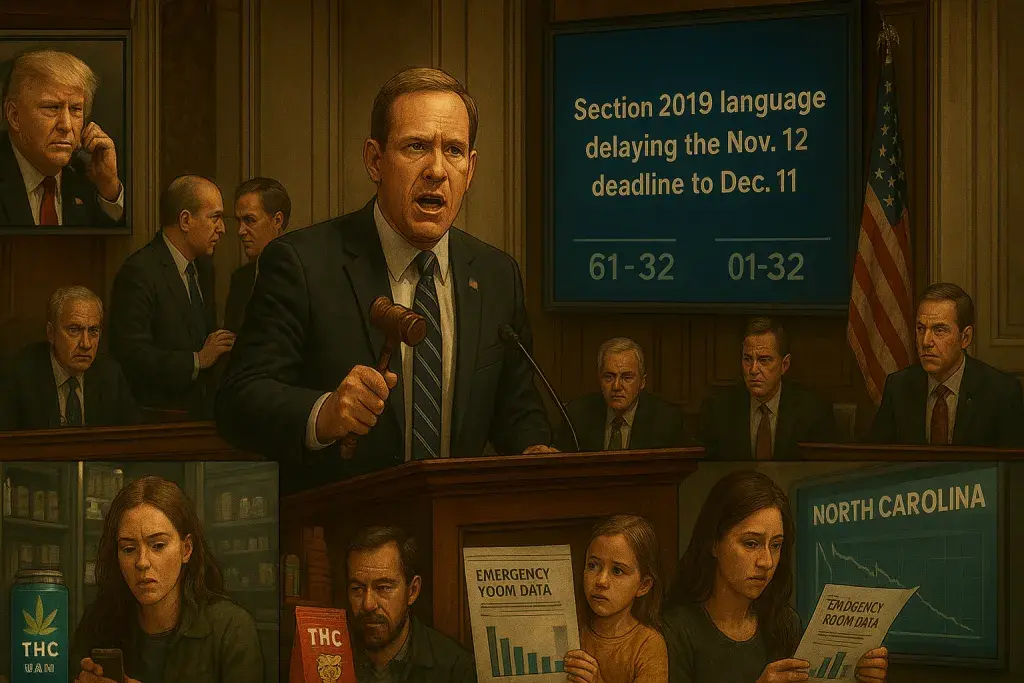
A one-month reprieve for intoxicating hemp products survived a Senate floor fight last week, but the win was narrow enough to leave dispensary operators, hemp retailers, and compliance teams with more questions than answers. Sen. Ted Budd, R-NC, tried to strip Section 2019 from the continuing resolution - language that pushes the effective date of sweeping federal hemp restrictions from Nov. 12 to Dec. 11 - and came within striking distance of succeeding. The 61-32 vote to table his amendment crossed party lines, with 21 Republicans joining 11 Democrats in wanting the restrictions to take effect on schedule.
For retailers selling hemp-derived cannabinoid products, the stakes are not abstract. The underlying law, passed in November 2025, redefines hemp around total THC and bars finished products containing more than 0.4 milligrams of combined total THC and similar cannabinoids per container. That threshold would functionally eliminate most THC beverages, vapes, gummies, and THCA flower currently sold in convenience stores, smoke shops, and even some general retail outlets. Operators who have spent the past several years building compliant packaging, batch testing, and point-of-sale infrastructure around a looser hemp standard now face a compressed runway to either reformulate SKUs or exit categories entirely. Multi-state operators watching this fight closely are the same ones who, in adult-use and medical cannabis channels, already lean on seed-to-sale systems and platforms like an Oregon dispensary POS platform to manage compliance logs, inventory shrinkage, and shifting tax obligations - a reminder that regulatory whiplash is not new to cannabis retail, even if this particular version is hitting the hemp side of the market first. Oregon dispensary POS platform
Public Safety Framing Versus Retail Reality
Budd built his case around child safety, citing North Carolina emergency department data showing cannabis consumption-coded visits among minors rose sharply between 2017 and 2025. His floor remarks focused on packaging that mimics familiar snack and candy brands - a criticism that has dogged the intoxicating hemp sector for years and one that regulators in both hemp and cannabis markets have struggled to police consistently. The argument resonated with 21 Republicans and 11 Democrats, but it did not carry the day. Opponents, including 105 organizations that wrote to Senate leadership, argued that a 30-day delay was not about protecting an unregulated market but about buying time for Congress to write actual guardrails: age limits, testing standards, good manufacturing practices, and restrictions on synthetic cannabinoid imports.
Administration Pressure and a Fractured GOP
The White House's involvement complicated matters further. President Trump reportedly called Budd directly as the dispute unfolded, and CMS Administrator Dr. Mehmet Oz publicly warned that letting the broader restrictions take effect Nov. 12 could disrupt access to full-spectrum hemp-derived CBD for seniors and people with disabilities - a claim Budd pushed back on. Behind closed doors, according to Axios, a Senate Republican lunch turned tense when Budd, Sen. Pete Ricketts, and Sen. Tom Cotton pressed for the restrictions to proceed as scheduled, only to be told by a White House legislative affairs official that no further extension would be sought. That single-line commitment matters for operators: it suggests Dec. 11 is being treated in Washington as a hard stop, not a placeholder.
North Carolina's Parallel Standoff
The federal fight has a direct echo in Raleigh, where House Bill 328 would import the same 0.4-milligram threshold into state law regardless of what Congress ultimately does. The Senate approved the conference report 37-6 back on July 2, but the House has repeatedly declined to act, leaving the bill parked in the Rules Committee. Speaker Destin Hall has acknowledged broad agreement that the state's largely unregulated hemp market cannot continue as-is, even as lawmakers remain split on the fix. For retailers operating in North Carolina, that means two overlapping deadlines - one federal, one state - that may or may not converge, and a real possibility that state law could outlast whatever Congress decides to do next.