Everyone watching cannabis stocks tends to fixate on the same two states. California is saturated and margin-compressed; Colorado matured years ago and has largely stopped growing. If you want to understand where multi-state operators might actually expand their footprint over the next few years, the more useful conversation is happening in Virginia and Texas - two markets moving at very different speeds, under very different regulatory frameworks, but both worth tracking closely.
Virginia's path is the more straightforward one. State lawmakers approved a regulated adult-use retail structure earlier this year, with sales set to begin July 1, 2027, and a cap of up to 350 dispensary licenses statewide. That's a meaningful runway for operators who already hold medical licenses, since Virginia's system rewards vertical integration - cultivation, processing, and retail under one roof - rather than opening the door wide to new entrants. For established operators, the compliance groundwork is already built: seed-to-sale tracking systems, testing protocols, and point-of-sale infrastructure running on platforms like the HIPAA-compliant dispensary software many medical operators rely on to manage patient records and inventory. That existing back-office architecture doesn't have to be rebuilt when adult-use sales begin; it just has to scale.
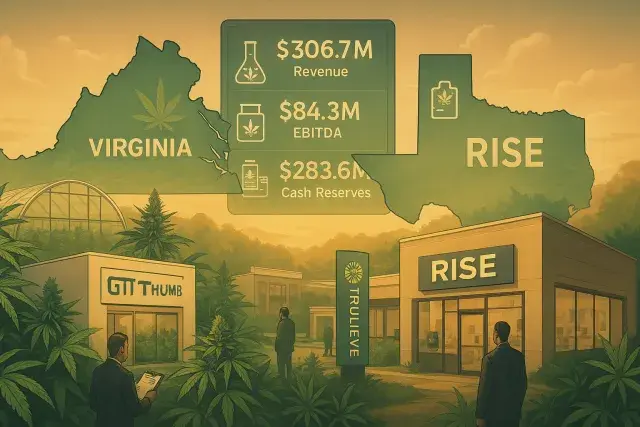
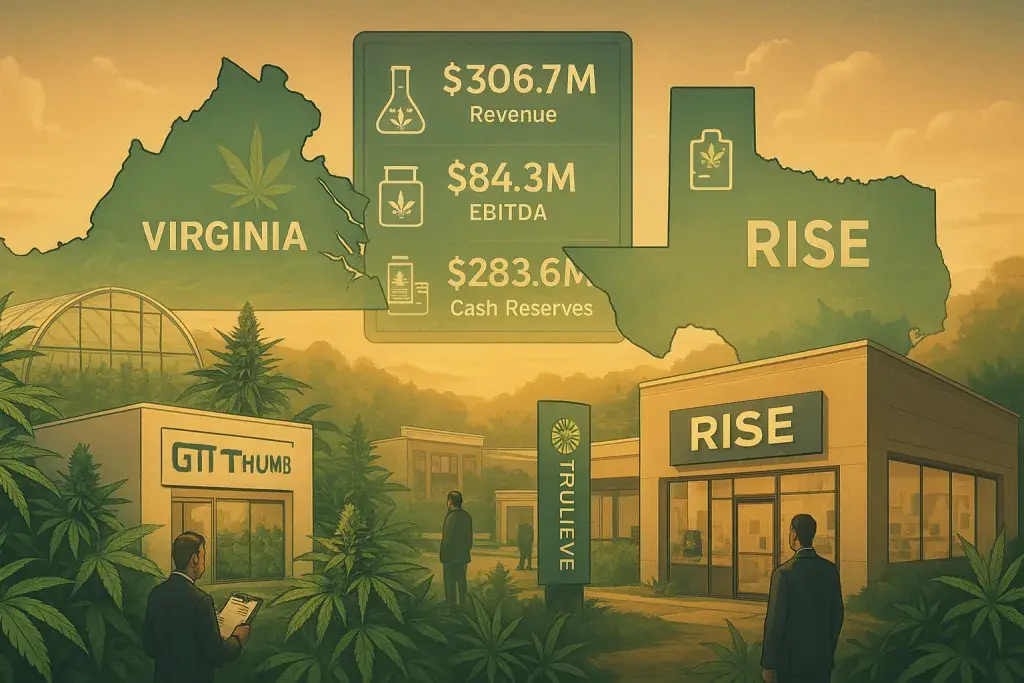
Green Thumb Industries is the clearest example of that positioning. The company holds one of Virginia's five vertically integrated pharmaceutical processor licenses, operating through its RISE dispensary brand, and it enters the adult-use transition with cultivation, processing, and retail operations already running. Financially, the company looks like one of the sturdier names in the sector: in the second quarter of 2026, it reported $306.7 million in revenue, $84.3 million in normalized EBITDA, $29 million in operating cash flow, and $4.9 million in GAAP net income, while closing the quarter with $283.6 million in cash on hand. That cash position matters more than it might seem. Cannabis companies still can't access traditional bank lending the way most retailers can, and Section 280E of the federal tax code prevents plant-touching businesses from deducting ordinary business expenses, which squeezes margins industry-wide. Operators who can fund expansion from cash flow, rather than dilutive equity raises or high-interest debt, hold a structural advantage.
Verano's Quiet Position in Virginia
Verano Holdings occupies similar ground. It already runs a vertically integrated medical license in Virginia, which means cultivation capacity, processing infrastructure, and dispensary locations are in place ahead of the adult-use conversion. In a limited-license state, that head start isn't a minor detail - it's the difference between competing for shelf space in a crowded wholesale market and simply expanding an operation that already has regulatory relationships, compliant packaging systems, and lab-testing partnerships established.
Texas Moves Slower, But the Math Still Works
Texas is a different story entirely. There's no adult-use conversation happening at the state level, and the Compassionate Use Program remains narrow compared to most medical markets, with qualifying conditions expanding only gradually. But Texas has more than 32 million residents, and the state runs a limited-license system, meaning only a small number of companies are authorized to cultivate, process, and dispense medical cannabis at all. That scarcity is the point. Trulieve Cannabis secured a conditional license late last year, and Green Thumb picked up a conditional dispensing organization license of its own. Neither company has to fight off a wave of new competitors if the program expands, because the licensing structure already locks most of that competition out.
Why Infrastructure Beats Headlines
Legalization news tends to move cannabis stocks fast, but not every operator benefits equally when a new market opens. The companies positioned to actually capture growth in Virginia and Texas already have what newer entrants lack: functioning cultivation facilities, retail operations, compliance staff who know how to work with state regulators, and balance sheets that don't depend on emergency financing. Trulieve remains one of the industry's largest and most consistently profitable operators. Verano has built its business specifically around limited-license states, where competition is thinner and wholesale pricing tends to hold up better over time.
None of this happens overnight. Virginia's adult-use market is still roughly a year away, and Texas continues to expand its medical program at a deliberate, bureaucratic pace. But for operators, landlords evaluating retail real estate, and suppliers building out wholesale relationships, the companies worth watching are the ones that already hold licenses and infrastructure in these two states - not the ones waiting for a headline to decide whether to show up.